




TL;DR — What You'll Learn
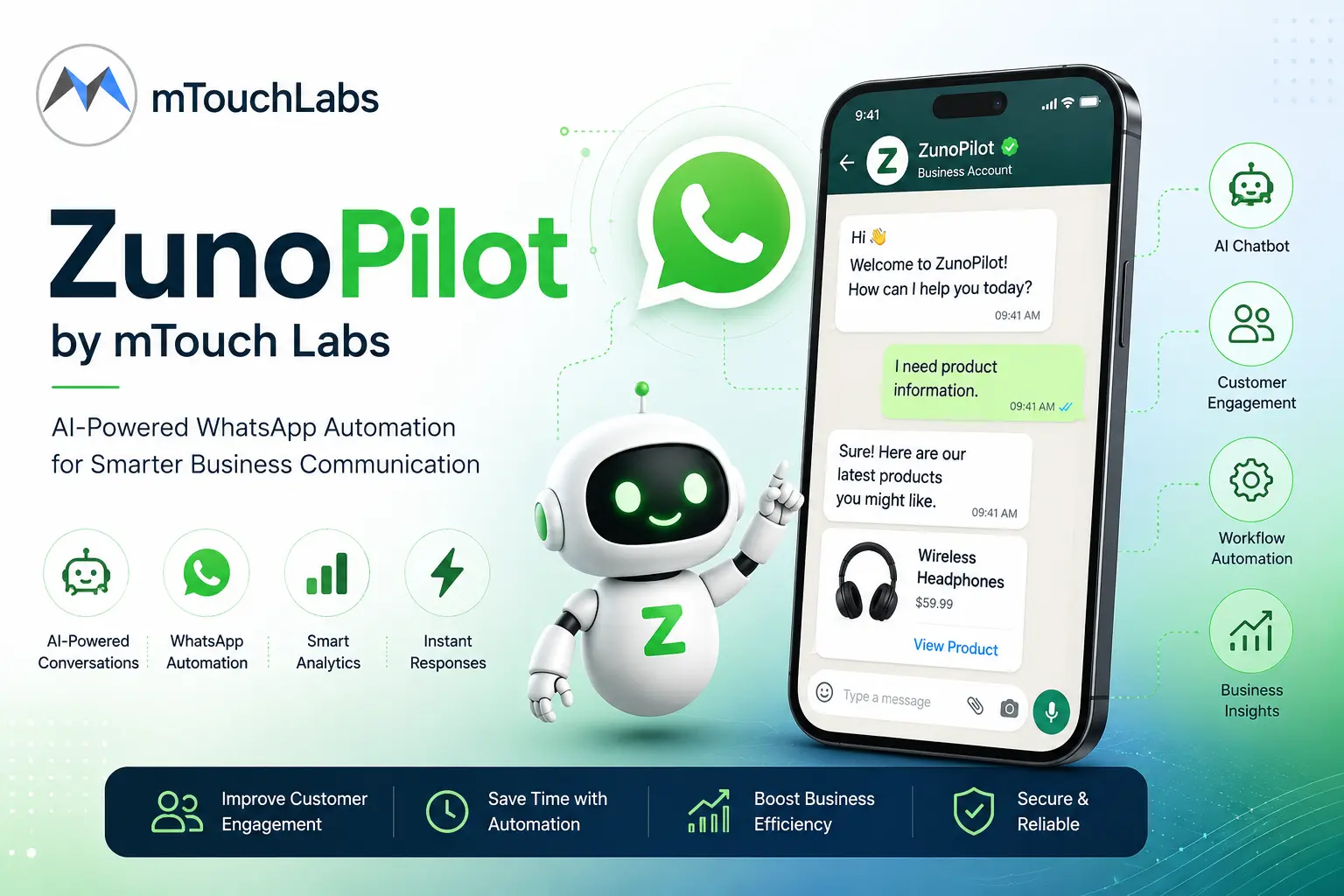
Discover how ZunoPilot by mTouch Labs uses AI-powered WhatsApp automation to streamline customer conversations, lead handling, and business workflows.
Quick Answer
What is AI WhatsApp automation?
AI WhatsApp automation uses artificial intelligence to understand customer messages, provide relevant responses, and support predefined business workflows through WhatsApp. Unlike basic rule-based automation, AI can interpret natural-language requests and help businesses manage more conversational interactions.
ZunoPilot by mTouch Labs applies this approach to business communication, helping organisations automate suitable WhatsApp interactions while keeping human teams involved when their expertise is needed.
Introduction
WhatsApp has become an important communication channel for businesses.
Customers use it to ask questions, enquire about products and services, request information, seek support, schedule appointments, and continue conversations with companies. For businesses, this creates a direct and familiar way to communicate with customers.
But as the number of conversations increases, managing them manually becomes harder.
Sales teams may receive dozens of enquiries every day. Support teams may repeatedly answer similar questions. Marketing and operations teams may need to manage customer communication and follow-ups across large volumes of conversations.
The challenge isn't simply sending messages.
The challenge is managing business communication at scale while keeping conversations useful, timely, and relevant.
At mTouch Labs, we looked at this challenge from a product-development perspective and explored how artificial intelligence could make WhatsApp communication more efficient. As an AI development company, that meant starting from the business workflow rather than the model.
That thinking led to ZunoPilot, our AI-powered WhatsApp automation solution designed to help businesses streamline conversations, automate suitable repetitive interactions, and connect customer communication with business workflows.
The goal isn't to automate every customer conversation.
It is to identify where intelligent automation can reduce repetitive work while keeping people involved when human judgment adds greater value.
The Problem We Saw at mTouch Labs
Businesses don't necessarily have a communication problem.
They have a communication-at-scale problem.
A growing business may start with a small number of WhatsApp conversations that employees can easily manage.
As enquiries increase, however, the same process becomes difficult to maintain. This is often the point at which organisations begin considering custom software development to support their workflows.
Response Delays
Customers increasingly expect timely communication.
When employees are handling multiple conversations simultaneously, responding to every enquiry immediately may not be possible.
An automated first interaction can help businesses acknowledge suitable enquiries and continue appropriate workflows while reducing dependence on immediate manual responses.
Repetitive Questions
Many businesses receive similar questions every day.
These may involve:
- Products
- Services
- Pricing information
- Availability
- Working hours
- Locations
- Appointments
- Delivery
- General policies
- Frequently requested information
For customers, these questions are important.
For employees, repeatedly answering the same questions consumes time.
This makes suitable routine interactions potential candidates for automation.
Missed Opportunities
A customer may contact a business outside working hours or during a period of high demand.
Without an appropriate automated workflow, the enquiry may remain unanswered until someone becomes available.
That delay can affect customer engagement and lead conversion.
AI-powered WhatsApp automation can help maintain an initial interaction and collect relevant information while the business team prepares to take over when required.
Manual Follow-Ups
A customer enquiry may require multiple interactions before becoming a sale, appointment, or business relationship.
When follow-ups are managed entirely through memory or spreadsheets, some conversations can be missed.
A structured WhatsApp workflow can help businesses create more consistent follow-up processes.
What Makes AI WhatsApp Automation Different?
Traditional WhatsApp automation typically relies on predefined rules.
For example:
Keyword → Rule → Predefined Response
This approach is effective for simple and predictable interactions.
However, customers don't always communicate using exact keywords.
Consider these messages:
- "How much does your service cost?"
- "Can you tell me the pricing?"
- "What is the price for this?"
The wording is different, but the underlying intent may be similar.
AI can help interpret natural-language messages and identify the likely intent before continuing with the appropriate workflow.
This creates a different model:
Customer message → AI understanding → Business context → Workflow → Response or action
The result can be a more conversational experience without abandoning the business rules that control the workflow.
How We Approached ZunoPilot at mTouch Labs
At mTouch Labs, we didn't want to build a system that simply sends automated replies.
The more important question was:
How can a WhatsApp conversation become useful to the business beyond the message itself?
Imagine a customer says:
"I'd like to schedule a demo next week."
A simple chatbot may respond with a generic acknowledgement.
An intelligent workflow can potentially understand the request, collect relevant information, continue the configured conversation, and connect the enquiry with the appropriate business process.
The thinking becomes:
Conversation → Intent → Information → Workflow → Business Action
This is the foundation of the ZunoPilot approach.
AI-Powered Lead Conversations
WhatsApp can be an important entry point for sales enquiries.
Businesses may direct prospects to WhatsApp through websites, advertising, social media, referrals, QR codes, or other marketing channels.
The first conversation often involves gathering basic information.
An AI-assisted workflow can potentially help guide that interaction, and the resulting data can flow into CRM development services or an existing sales system.
Depending on the business, the conversation may collect information such as:
- Customer name
- Requirement
- Product or service of interest
- Location
- Expected timeline
- Additional requirements
The sales team can then receive better context before continuing the conversation.
Instead of spending the initial interaction collecting basic information, salespeople can focus more of their time on understanding requirements and moving qualified opportunities forward.
Supporting Lead Qualification Through WhatsApp
Not every enquiry has the same level of intent.
One customer may simply be researching.
Another may be comparing providers.
Someone else may already be ready for a sales conversation.
AI-assisted workflows can help businesses organise conversations according to predefined business criteria.
A simplified workflow could look like:
- New enquiry
- ↓
- Information collection
- ↓
- Requirement or intent identification
- ↓
- Business-defined qualification
- ↓
- Sales team involvement
The business remains responsible for defining its qualification criteria.
AI can assist with interpreting conversational information and moving the interaction through the appropriate workflow.
This distinction is important because automation should support business processes rather than make uncontrolled decisions.
Customer Support Without the Repetition
Customer support teams often handle a large number of routine questions.
These can include:
- Product information
- Service information
- Business hours
- Availability
- Appointment information
- Basic troubleshooting
- Frequently asked questions
- General support requests
AI-powered WhatsApp automation can assist with suitable first-level interactions, in the same way AI chatbot development supports website and in-app enquiries.
The workflow can follow a simple principle:
Routine request → Automated assistance
Complex request → Human support
This gives support teams more time to focus on cases where their experience and judgment are genuinely required.
Follow-Ups Without Relying Entirely on Memory
A customer enquiry does not always result in an immediate decision.
Customers may need:
- More information
- A quotation
- A product demonstration
- An appointment
- A reminder
- Additional clarification
As enquiry volumes increase, manually remembering every follow-up becomes difficult.
A structured WhatsApp workflow can help businesses organise appropriate customer journeys.
For example:
Initial enquiry → Response → Follow-up → Reminder → Human interaction
The purpose is not to send more messages.
The purpose is to make important customer journeys more organised and consistent.
Businesses should always design follow-up frequency around customer expectations, consent, and applicable WhatsApp requirements.
Connecting WhatsApp Conversations With Business Workflows
A major opportunity in AI-powered WhatsApp automation is connecting communication with actual business processes, which usually depends on API integration services linking WhatsApp to existing systems.
A customer message can become the starting point for an action.
For example:
Customer Request
"I want to know more about your service."
AI Understanding
The system identifies the likely intent.
Business Context
Relevant approved information is used to continue the conversation.
Workflow
The customer may be asked for additional information.
Next Action
The interaction can potentially move to the relevant business process or team.
This transforms WhatsApp from a simple communication channel into a possible interface for business workflows.
Where AI WhatsApp Automation Can Help
The opportunities vary by organisation.
| Business Function | Potential Applications |
|---|---|
| Sales | Lead enquiries, qualification, follow-ups |
| Customer Support | FAQs, initial assistance, routing |
| Marketing | Customer engagement and campaign workflows |
| Operations | Reminders, confirmations, notifications |
| Appointments | Enquiries and scheduling workflows |
| E-commerce | Product questions and customer communication |
| Real Estate | Property enquiries and lead qualification |
| Education | Course enquiries and admissions communication |
| Healthcare | Appointment-related communication |
| SaaS | Demo enquiries, onboarding assistance, support |
These are potential applications rather than claims that every workflow is currently available as a ZunoPilot feature. Multi-tenant products in this space are often delivered as SaaS development services.
Actual implementation depends on the business process, integrations, data requirements, and product configuration.
AI WhatsApp Automation Across the Customer Journey
WhatsApp automation doesn't have to be limited to the first customer interaction.
It can potentially support several stages of the customer journey.
Discovery
A potential customer asks a question.
Enquiry
The customer requests additional information.
Qualification
The business gathers relevant requirements.
Conversion
The customer moves toward a purchase, booking, consultation, or meeting.
Support
The customer needs assistance after the initial interaction.
Retention
The business maintains an appropriate ongoing relationship.
This makes WhatsApp automation potentially useful across multiple business processes rather than only as a customer-support chatbot.
Business Knowledge Makes AI More Useful
AI cannot reliably represent a business without appropriate context.
An organisation may need to provide approved information about:
- Products
- Services
- Frequently asked questions
- Business policies
- Operating hours
- Pricing information
- Support procedures
- Appointment rules
The information available to an AI workflow should be relevant, accurate, and maintained by the business.
This is why effective AI WhatsApp automation is more than connecting an AI model to WhatsApp. Practical generative AI development depends as much on grounding as on the model itself.
It brings together:
AI + Business Knowledge + WhatsApp + Workflow Logic + Integrations
Each layer contributes to the final customer experience.
Human Handoff Is Part of Good Automation
Automation should not create a barrier between customers and employees.
Some conversations require human judgment.
Examples include:
- Complex complaints
- High-value sales opportunities
- Sensitive customer situations
- Technical issues
- Negotiations
- Requests requiring professional expertise
For these situations, businesses need an appropriate human handoff process. In larger organisations this usually connects to existing enterprise software development systems.
The practical model is:
- AI handles suitable repetitive interactions.
- People handle conversations where expertise and judgment matter.
This makes automation more useful for businesses that want efficiency without sacrificing customer relationships.
Responsible WhatsApp Automation
AI-powered communication needs to be implemented responsibly.
Businesses should consider several areas.
Customer Consent
Businesses should follow applicable WhatsApp policies and customer consent requirements when initiating or continuing automated communication.
Data Protection
Customer information should be handled securely and according to applicable privacy requirements, supported by well-configured cloud and DevOps services.
Message Relevance
Automation should provide useful communication rather than unnecessary or excessive messages.
Accuracy
Automated responses should be based on reliable and approved business information.
Human Escalation
Customers should have an appropriate route to human support when necessary.
Responsible automation is ultimately about improving the customer experience while maintaining trust.
Measuring the Business Impact
Implementing automation is only the beginning.
Businesses need to understand whether their workflows are actually producing better outcomes.
Depending on the use case, relevant metrics may include:
- Average response time
- Conversations handled
- Lead qualification rate
- Human handoff rate
- Follow-up completion
- Appointment conversions
- Support resolution
- Lead conversion
- Customer engagement
These metrics can help teams identify successful workflows and areas that require improvement.
AI automation should be continuously refined based on real customer interactions and measurable business outcomes.
Why ZunoPilot Is More Than an Auto-Reply System
A basic auto-reply system answers a message.
The ZunoPilot concept is focused on connecting the conversation with the wider business workflow.
The model is:
- Customer conversation
- ↓
- AI understanding
- ↓
- Relevant business information
- ↓
- Workflow
- ↓
- Response or action
- ↓
- Human handoff when required
This approach allows WhatsApp to become part of a broader customer journey instead of functioning only as a messaging endpoint.
The mTouch Labs Product Perspective
As a software development company, mTouch Labs works across software development, AI, SaaS, cloud, mobile, web, and digital product engineering.
ZunoPilot brings these capabilities together around a focused business challenge:
How can businesses manage increasing WhatsApp communication without increasing repetitive manual work at the same rate?
Our approach is to use AI where it creates practical value while keeping businesses in control of their workflows.
That means looking at four important stages:
Understand
Interpret what the customer is asking.
Assist
Provide useful and relevant information.
Automate
Reduce appropriate repetitive communication and workflow steps.
Escalate
Bring a human into the conversation when human judgment is required.
The focus remains on business outcomes rather than AI features alone.
Why WhatsApp Is an Important Automation Channel
One of WhatsApp's biggest advantages is familiarity.
Customers already understand how to open the application, send a message, share information, and continue a conversation.
Businesses therefore don't necessarily need to introduce an entirely new communication interface.
The interaction can start naturally:
Open WhatsApp → Send a message → Continue the conversation
The challenge is making automation genuinely helpful.
That requires relevant information, sensible workflows, responsible messaging, and human escalation.
When these elements work together, WhatsApp can become more than a communication channel.
It can become an interface for business interaction.
The Future of AI-Powered WhatsApp Automation
Business messaging is moving beyond simple predefined replies.
AI can help systems understand natural-language requests.
Automation can connect conversations with business processes.
Integrations can connect those processes with existing business systems.
Together, these capabilities create a new model:
Customer asks → AI understands → Workflow responds → Business action
The opportunity isn't to remove people from the customer journey.
It is to make sure human attention is focused where it creates the greatest value.
This is the direction mTouch Labs sees for ZunoPilot, and one of several AI solutions for businesses we continue to explore.
How Businesses Should Approach WhatsApp Automation
Businesses considering AI WhatsApp automation should start with the workflow—not the technology.
Ask:
- Which WhatsApp enquiries are repetitive?
- How much employee time do they consume?
- Where are leads being missed?
- Which follow-ups are difficult to manage?
- Which interactions require immediate responses?
- Which processes can safely be automated?
- Where should human approval remain necessary?
These questions help identify practical automation opportunities.
The objective should not be:
"Automate everything."
It should be:
"Automate the right things."
Final Thoughts
WhatsApp is already an important communication channel for many businesses.
The next opportunity is making those conversations more intelligent.
ZunoPilot by mTouch Labs is our approach to AI-powered WhatsApp automation, bringing together conversational AI, business information, workflow automation, and human support to help businesses manage communication more effectively.
The objective is straightforward:
- Automate the repetitive.
- Assist the customer.
- Connect the workflow.
- Keep humans involved when they matter.
As AI becomes increasingly integrated into business operations, messaging platforms such as WhatsApp can evolve from communication channels into intelligent interfaces for business interactions.
With ZunoPilot, mTouch Labs is exploring that future through a practical question:
How can AI help businesses turn everyday WhatsApp conversations into useful business outcomes?
Contact mTouch Labs to discuss how AI-powered WhatsApp automation could fit your business workflows.
Frequently Asked Questions
What is AI WhatsApp automation?
What is ZunoPilot?
How can AI WhatsApp automation help businesses?
Is AI WhatsApp automation the same as a chatbot?
Can ZunoPilot help with lead generation?
Can WhatsApp automation replace customer support teams?
Which businesses can use AI WhatsApp automation?
Is customer consent important for WhatsApp automation?
How do I get started with AI WhatsApp automation?
🎯 Key Takeaways
Discover how ZunoPilot by mTouch Labs uses AI-powered WhatsApp automation to streamline customer conversations, lead handling, and business workflows.