


Deliver faster, smarter customer service with an AI customer support system that understands customer questions, retrieves relevant information, automates repetitive requests, and connects customers with human support when needed. mTouch Labs develops custom AI customer support solutions across websites, applications, and digital channels — connected to your CRM and wider software ecosystem.
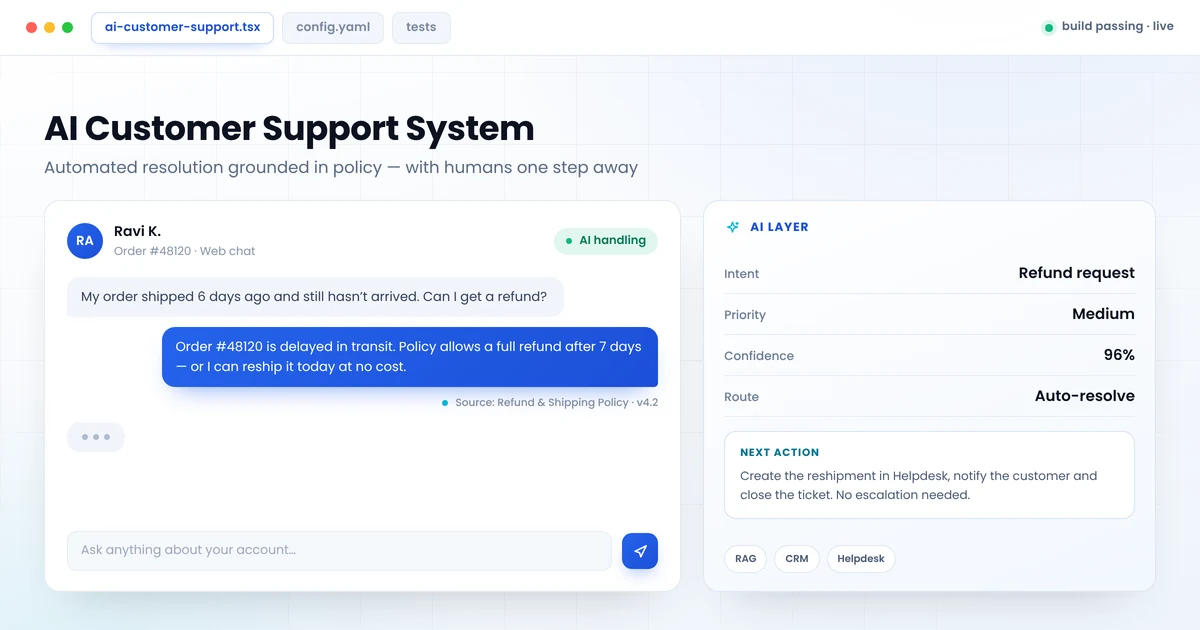
Traditional customer support often depends on repetitive manual responses, large ticket volumes, and customers waiting for assistance.
An AI customer support system can help automate common interactions, understand customer intent, retrieve information from approved business knowledge, classify support requests, and assist human support teams.
mTouch Labs builds AI-powered customer support systems around your products, services, customers, knowledge base, workflows, and existing business applications.
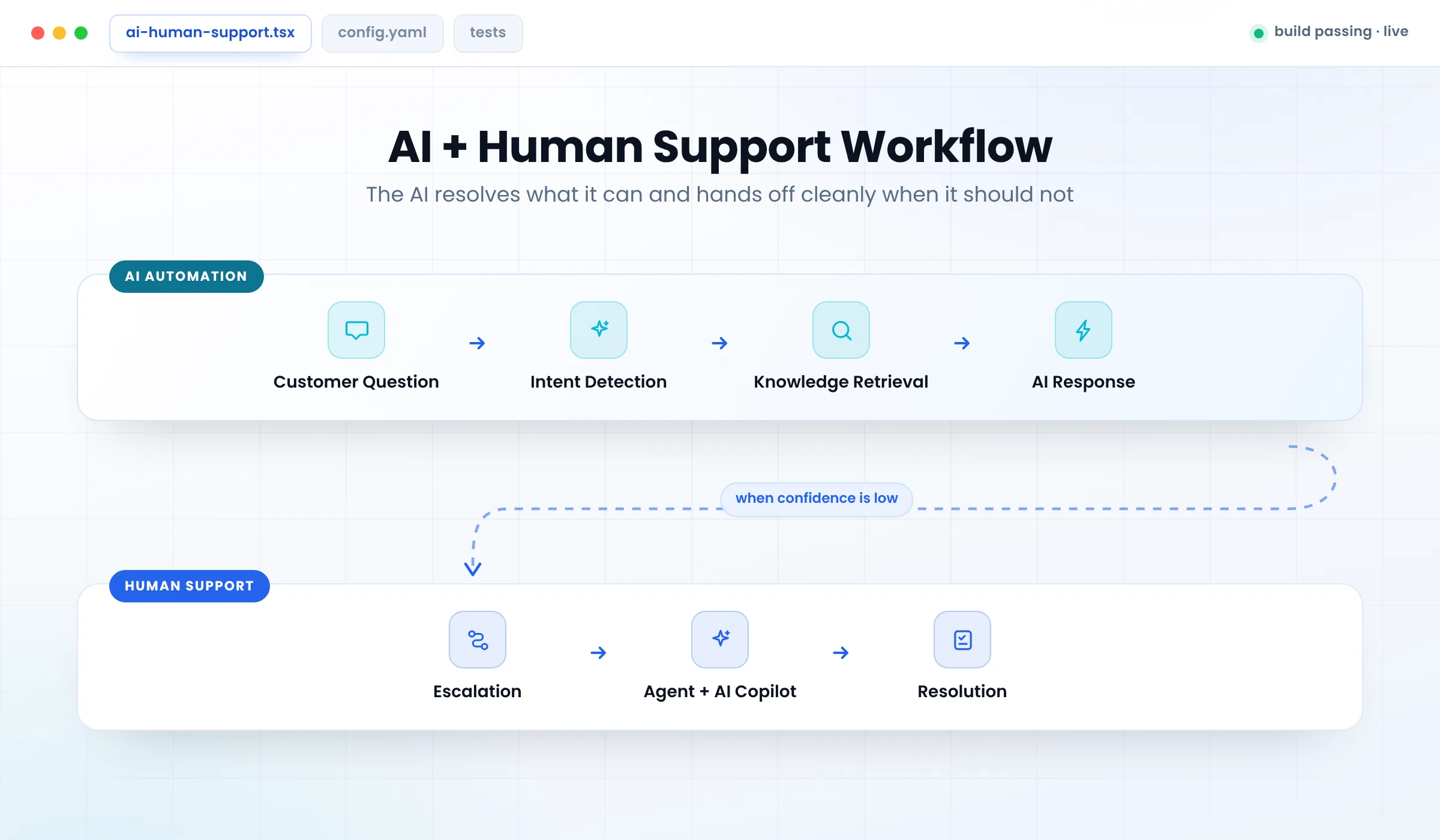
Ten capabilities that combine into one support system rather than a set of disconnected tools
Conversational AI experiences that answer customer questions using your approved business information and predefined support workflows. Related: AI Chatbot Development.
AI agents that can retrieve information, use connected tools, and perform defined support tasks rather than only answering questions.
Automatically understand incoming support requests, categorize them, prioritize them, and route them to the appropriate workflow or support team.
Connect your support system with product documentation, FAQs, manuals, policies, and other approved business information.
Help human support representatives find information, summarize conversations, draft responses, and handle repetitive support activities more efficiently.
Automate repetitive customer service workflows while keeping human intervention available for complex or sensitive requests.
Connect AI support systems with your existing CRM, helpdesk, customer portal, databases, and business APIs.
Serve customers across your website, mobile app, customer portal, email, and messaging channels such as WhatsApp — from one AI support core and one knowledge source.
Handle customer conversations in multiple languages from the same approved knowledge base, so support coverage expands without duplicating content or teams.
Extend the same support intelligence to phone and IVR conversations — transcribe calls, understand intent, answer routine questions, and hand off to an agent with the transcript attached.
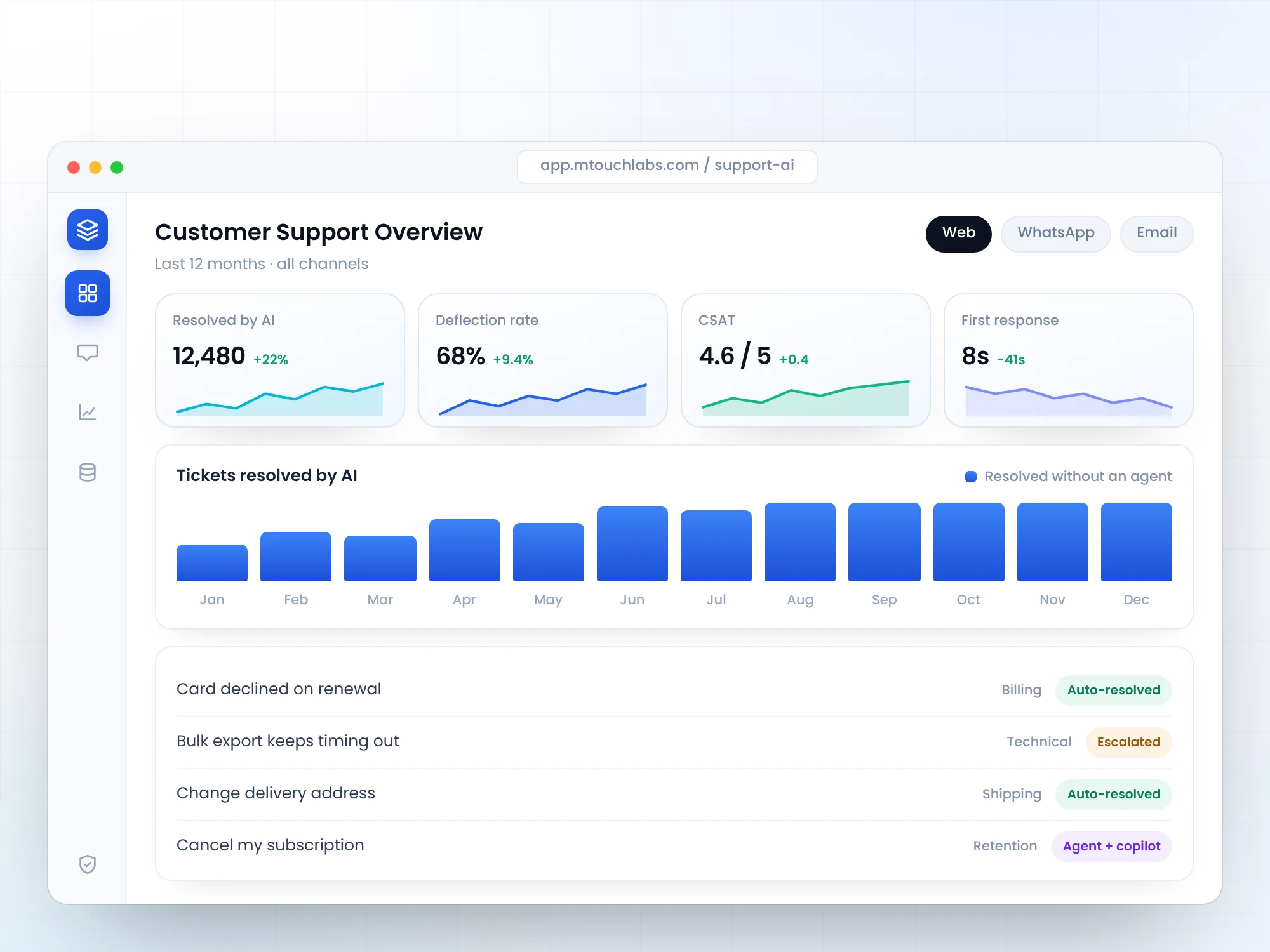
Eight features that decide whether support automation actually holds up in production
Immediate responses to common questions outside traditional support hours.
Maintain relevant conversational context for more natural interactions.
Ground responses in approved business information and documentation.
Classify customer requests and route them by your support workflows.
Transfer to human representatives when the request needs more assistance.
AI help for searching information, summarizing threads and drafting replies.
Connect support conversations with customer records and business workflows.
Track conversations, common queries, resolution patterns and defined metrics.
For knowledge-based support, the system retrieves relevant information from approved business sources before generating a response. For workflow-based support, it can connect with APIs or business applications to retrieve or update information according to defined permissions and rules.
Five layers that let AI automation and human support work together rather than as separate systems
Website, mobile application, customer portal, or messaging channel.
Understands the customer’s request and maintains conversational context.
Retrieves relevant information from approved documents, FAQs, databases, or knowledge repositories.
Connects with CRM, helpdesk, APIs, databases, and other systems.
Escalates conversations when human intervention is required.
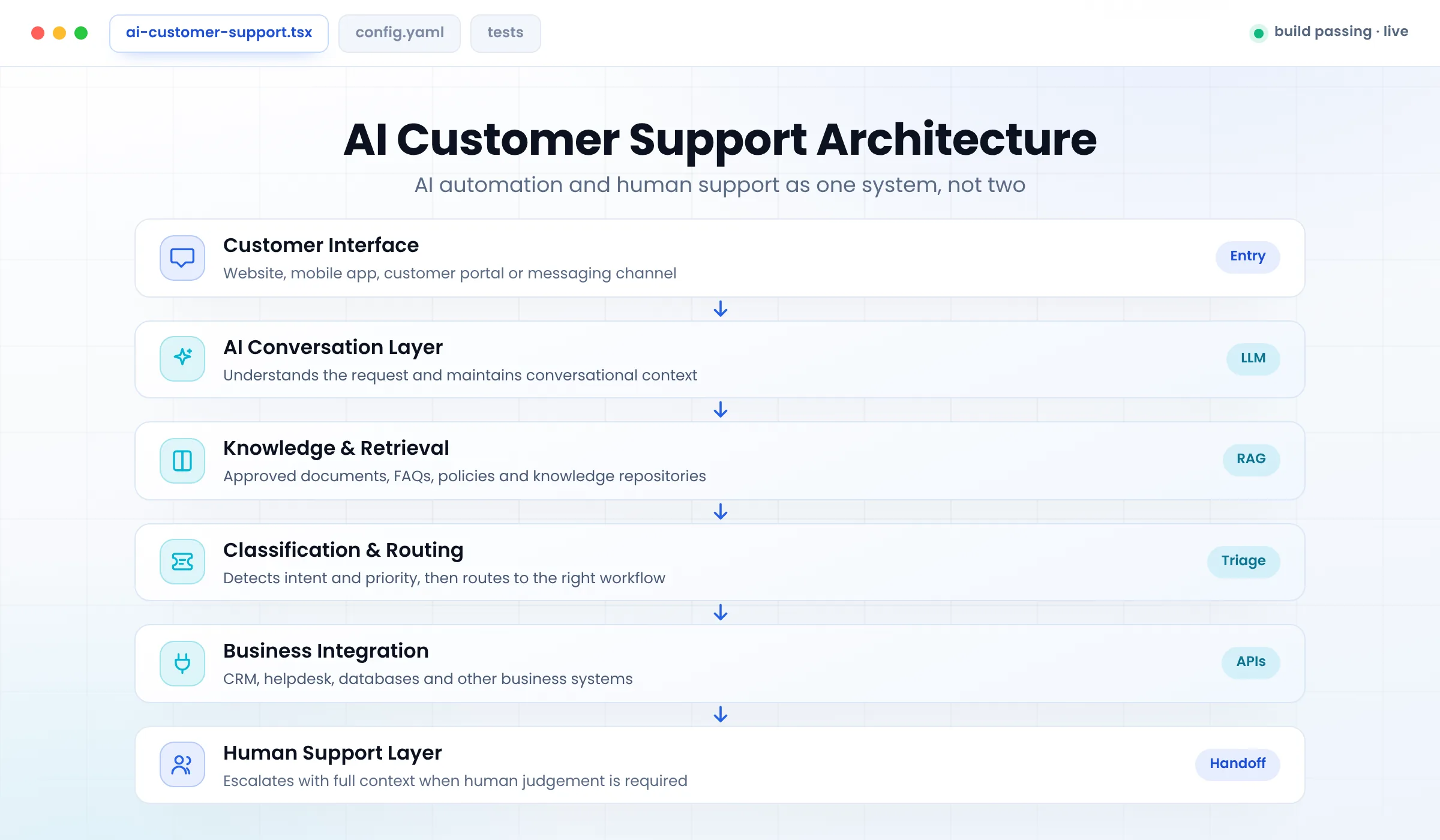
This architecture allows AI automation and human support to work together rather than treating them as separate systems.
The same platform, adapted to each industry’s knowledge sources and workflows
Product questions, order-related enquiries, returns, shipping information, and common purchasing questions across your ecommerce platform.
Help users understand product features, search documentation, troubleshoot common issues, and navigate support resources inside your SaaS product.
Approved informational workflows such as account-related FAQs, product information, and service navigation. Sensitive financial decisions should remain subject to appropriate human and system controls.
Approved administrative and informational workflows such as appointment-related enquiries and service information. AI should not replace qualified professionals for diagnosis or treatment decisions.
Automate questions about bookings, services, policies, destinations, and customer requests.
Assist customers with property-related enquiries, listing information, lead qualification, and appointment workflows.
Help students and users find information about courses, programs, admissions, schedules, and other approved resources.
Policy coverage questions, document requirements, renewal and claim-status enquiries, with complex cases routed to licensed staff. Coverage and claim decisions stay under human and system control.
Shipment tracking, delivery-window questions, address changes, and delayed or failed delivery exceptions — with live status pulled from your own systems.
Plan and billing enquiries, usage questions, outage and service status, SIM or connection requests, and appointment booking for field visits.
Store hours and locations, stock availability, order pickup, warranty and returns, and loyalty programme questions across online and in-store customers.
Order status, menu and allergen questions, refunds for missing or late items, and delivery issues — wired into your food delivery platform.
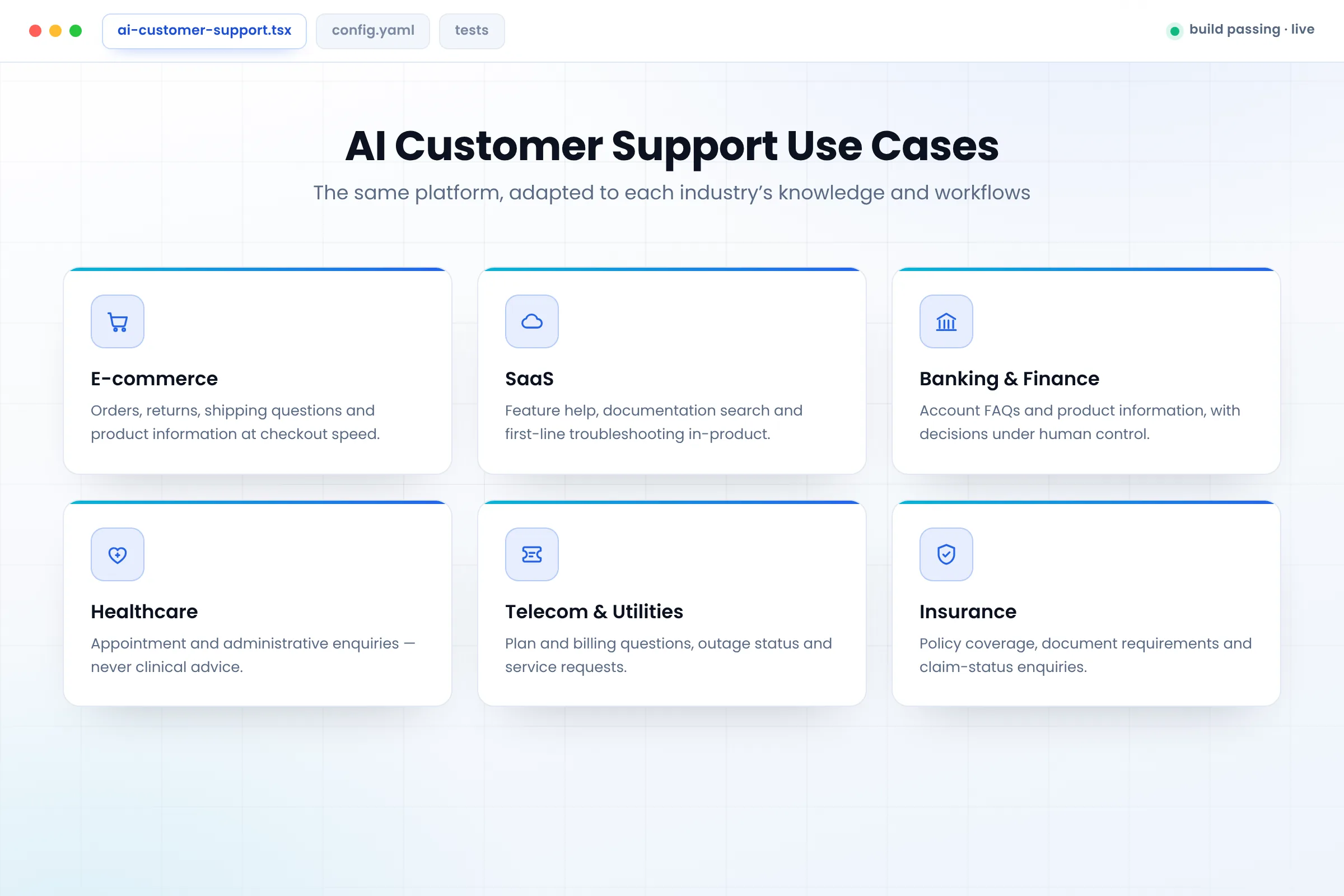
mTouch Labs combines AI development, software engineering, application development, data technologies, and system integration to build customer support solutions around real business requirements. Browse our portfolio and case studies for shipped examples.
The same architecture, scoped to the size of the support operation around it
Automate repetitive customer questions without requiring a large support operation.
Combine AI automation with human support to handle increasing customer interaction volumes.
Integrate AI customer support with existing knowledge systems, CRM platforms, helpdesks, applications, and enterprise workflows.
Conversational AI, business knowledge, automation and integration built around one support core rather than a set of disconnected tools.
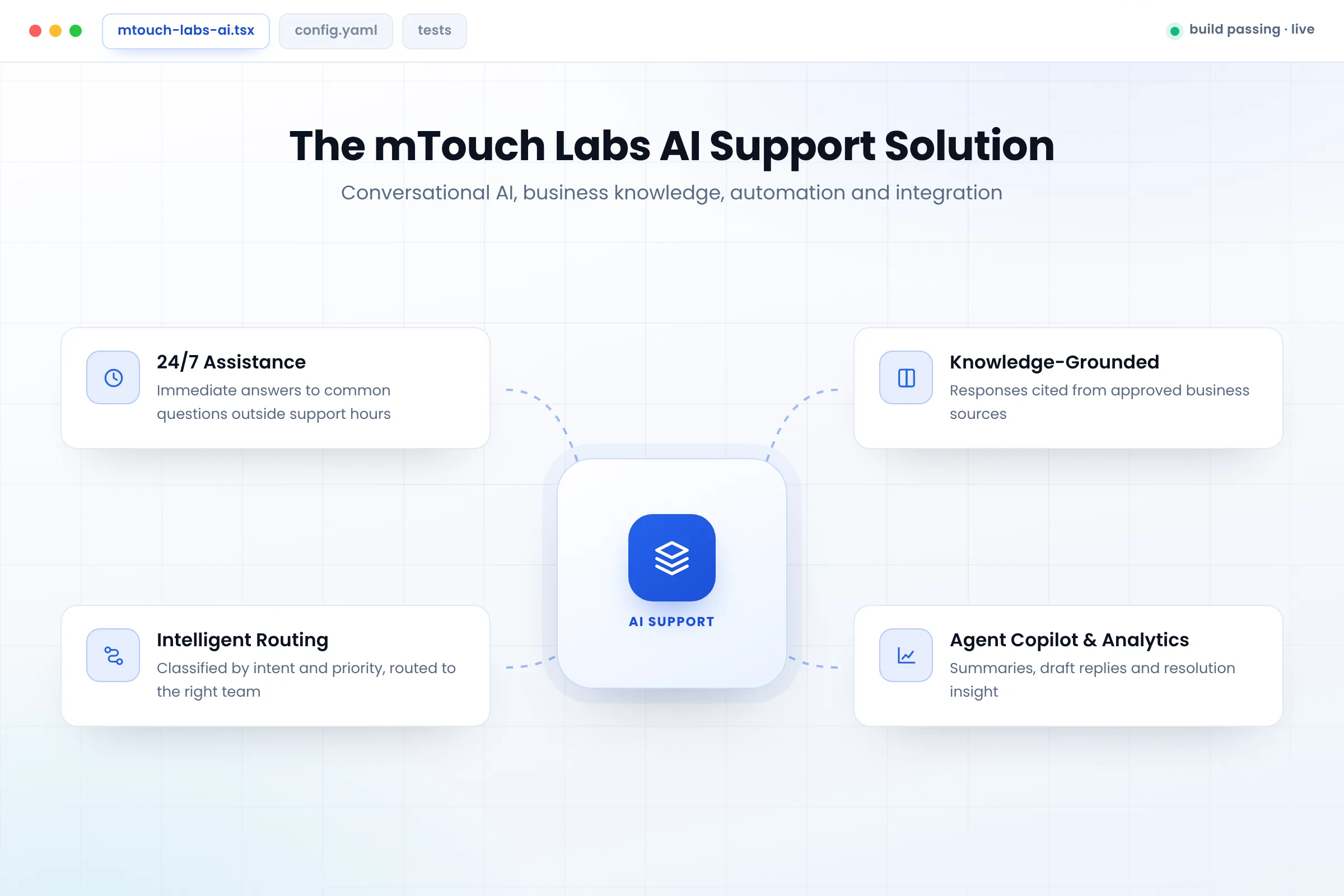
The stack is selected according to the required accuracy, latency, scalability, security, integrations, and operating cost — not a fixed architecture applied to every project.
Six stages from support workflow discovery through to continuous optimization
We analyze your customer journeys, support requests, existing systems, knowledge sources, and automation opportunities.
We define the AI model strategy, knowledge architecture, integrations, workflows, escalation logic, and security requirements.
Your approved FAQs, documentation, product information, policies, and other relevant sources can be prepared for AI retrieval.
We build the conversational experience, support workflows, integrations, and AI capabilities required for your use case.
We evaluate response quality, retrieval accuracy, conversation flows, edge cases, integrations, and escalation behaviour.
After deployment, the system can be monitored and refined based on customer interactions, support requirements, and business feedback.
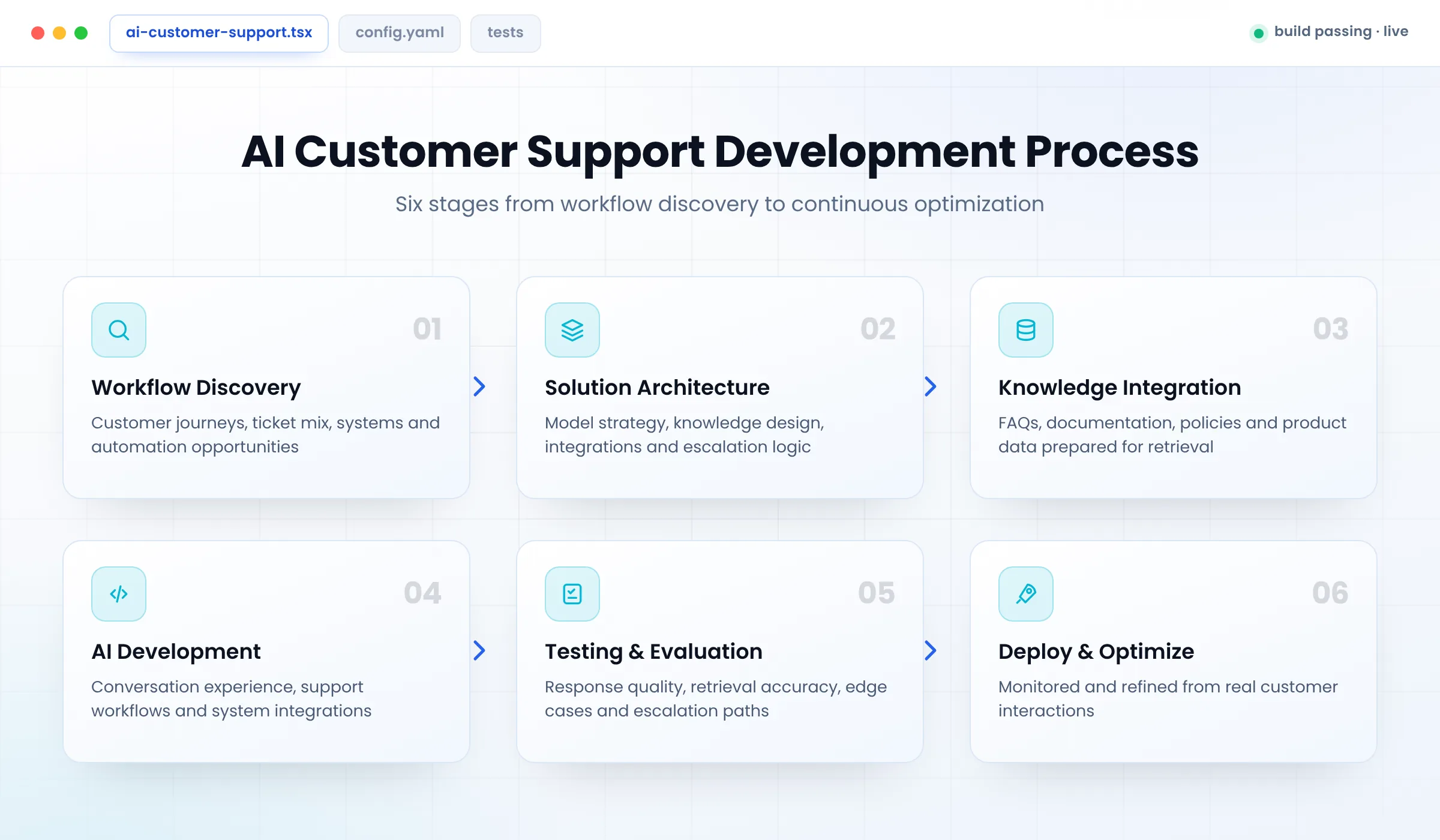
The exact capabilities depend on your business workflows, data, integrations, and required level of automation.
Capabilities most often built alongside an AI customer support system
Custom AI chatbots with RAG, LLM integration and enterprise connectors.
LLM-powered applications, RAG pipelines and production AI automation.
The system your support conversations and qualified leads land in.
Prediction, classification and scoring models behind support intelligence.
In-product support assistants for your software platform.
Independent evaluation of AI responses, retrieval quality and edge cases.
Everything about AI customer support system development
An AI customer support system is software that uses artificial intelligence to understand customer requests, retrieve information, provide responses, automate support workflows, and assist human support teams.
AI can automate repetitive interactions, provide faster responses, help agents find information, classify support requests, and support customers outside traditional service hours.
Yes. Approved FAQs, documentation, policies, product information, and other business knowledge can be connected to an AI support system.
Yes. AI support systems can integrate with CRM platforms and other business applications through available APIs and appropriate access controls.
Yes. Human escalation can be incorporated when a conversation requires human expertise or falls outside the AI system's defined capabilities.
Not necessarily. An AI chatbot is primarily a conversational interface, while an AI customer support system can include chat, knowledge retrieval, ticket automation, CRM integration, agent assistance, analytics, and human escalation.
Development cost depends on the required features, AI architecture, integrations, data sources, security requirements, channels, and expected usage.
Give customers faster access to information while helping your support team spend less time on repetitive tasks. mTouch Labs develops custom AI customer support systems that combine conversational AI, business knowledge, automation, and software integrations. Talk to mTouch Labs about your project.
 Chat with us!