


Deliver personalized experiences with an AI recommendation engine that helps users discover the products, content, services, and experiences most relevant to them. mTouch Labs combines user behaviour, product or content data, business rules, and machine learning to create recommendation experiences tailored to your application.
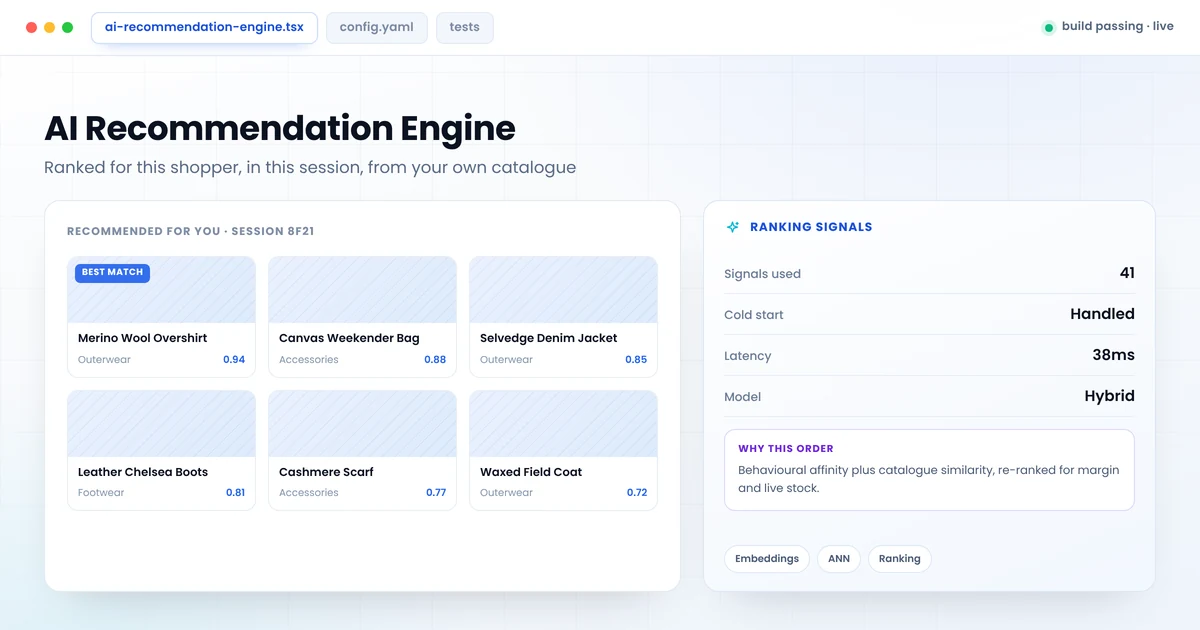
Customers increasingly expect digital platforms to understand their interests and show relevant options instead of making them search through endless choices.
An AI recommendation system analyzes available signals — interactions, preferences, product information, content characteristics and contextual data — to generate personalized recommendations.
The recommendation strategy is designed around your available data, business objectives and user experience — not a fixed algorithm applied to every project.
Seven capabilities that combine into one personalisation layer across your product
Engines built specifically for your application’s users, data, catalog and business objectives.
Help shoppers discover relevant products using behavioural and product-level signals across your ecommerce platform.
Recommend articles, videos, courses or other content based on available user and content signals.
Personalized experiences across homepages, search results, product pages and content pages.
Workflows that respond to recent interactions where your use case and infrastructure support it.
Combine multiple approaches to improve relevance across users, products and content.
Recommendation services consumed by websites, mobile apps, SaaS platforms and other products.
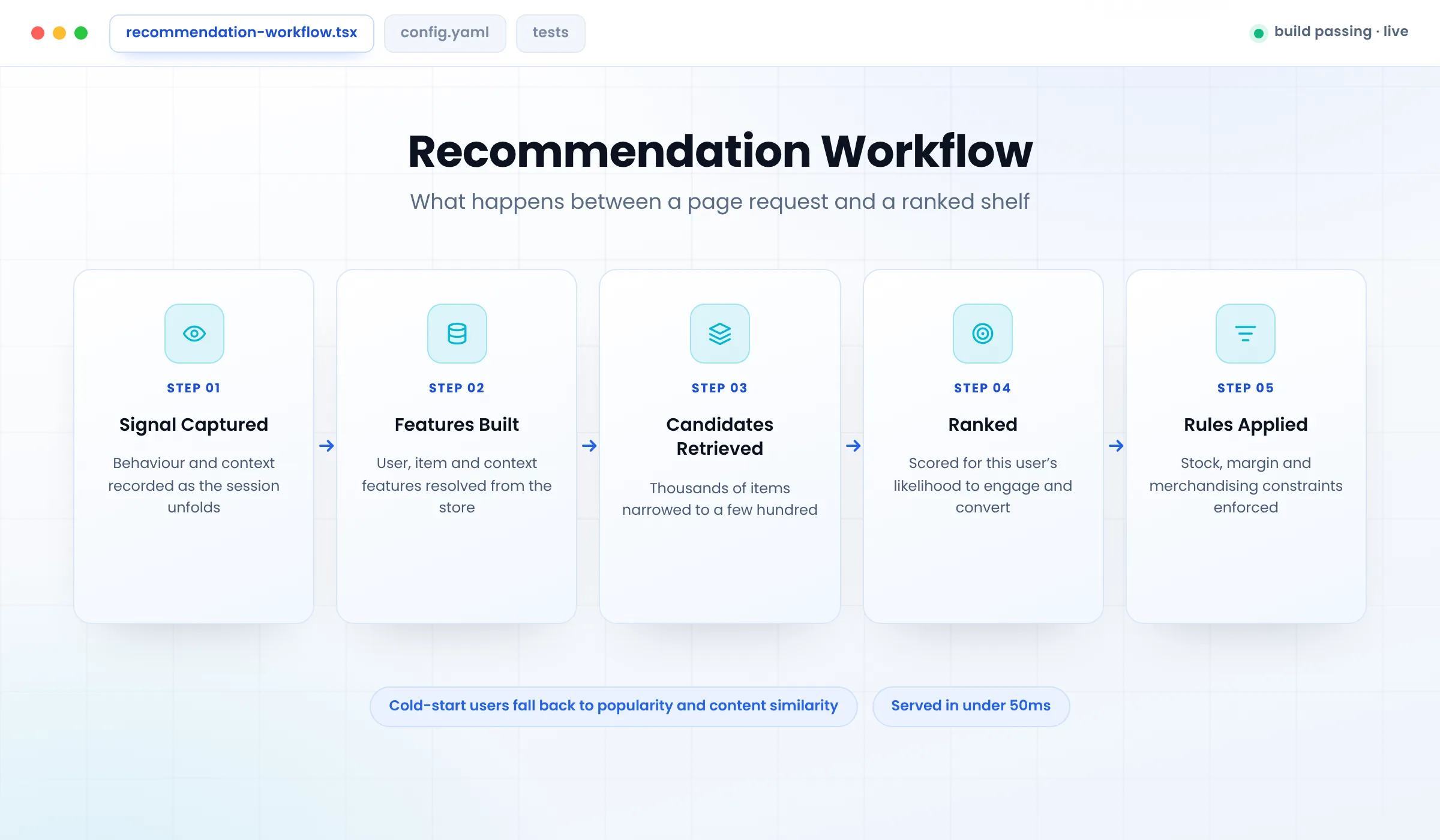
A recommendation system combines user information, item information, interaction data and contextual signals to determine which options may be relevant. An e-commerce platform, for example, uses product information and customer interactions to generate a candidate list and rank it by the application's strategy.
Which approach fits depends on the data you have, not on what is fashionable
Patterns between users and items — useful once your platform has enough historical interaction data to learn from.
Characteristics of the items themselves — identifies items similar to what a user has already interacted with.
Multiple approaches combined — uses different available signals together to cover more users and items.
Order, not just selection — ranks available items by user preference, context and business requirements.
Model output within your constraints — combines AI recommendations with eligibility, inventory and operational rules.
Eight features that turn a model into a personalisation layer your product can rely on
Representations of preference from behavioural and contextual signals.
Product, service or content characteristics inside the logic.
Narrow the catalog to a relevant set before ranking it.
Order candidates by the model and applicable business rules.
Adapt output to different users and different contexts.
Expose the engine to web, mobile and other applications.
Measure defined recommendation metrics and user interactions.
Update strategy as behaviour, catalogues and requirements change.
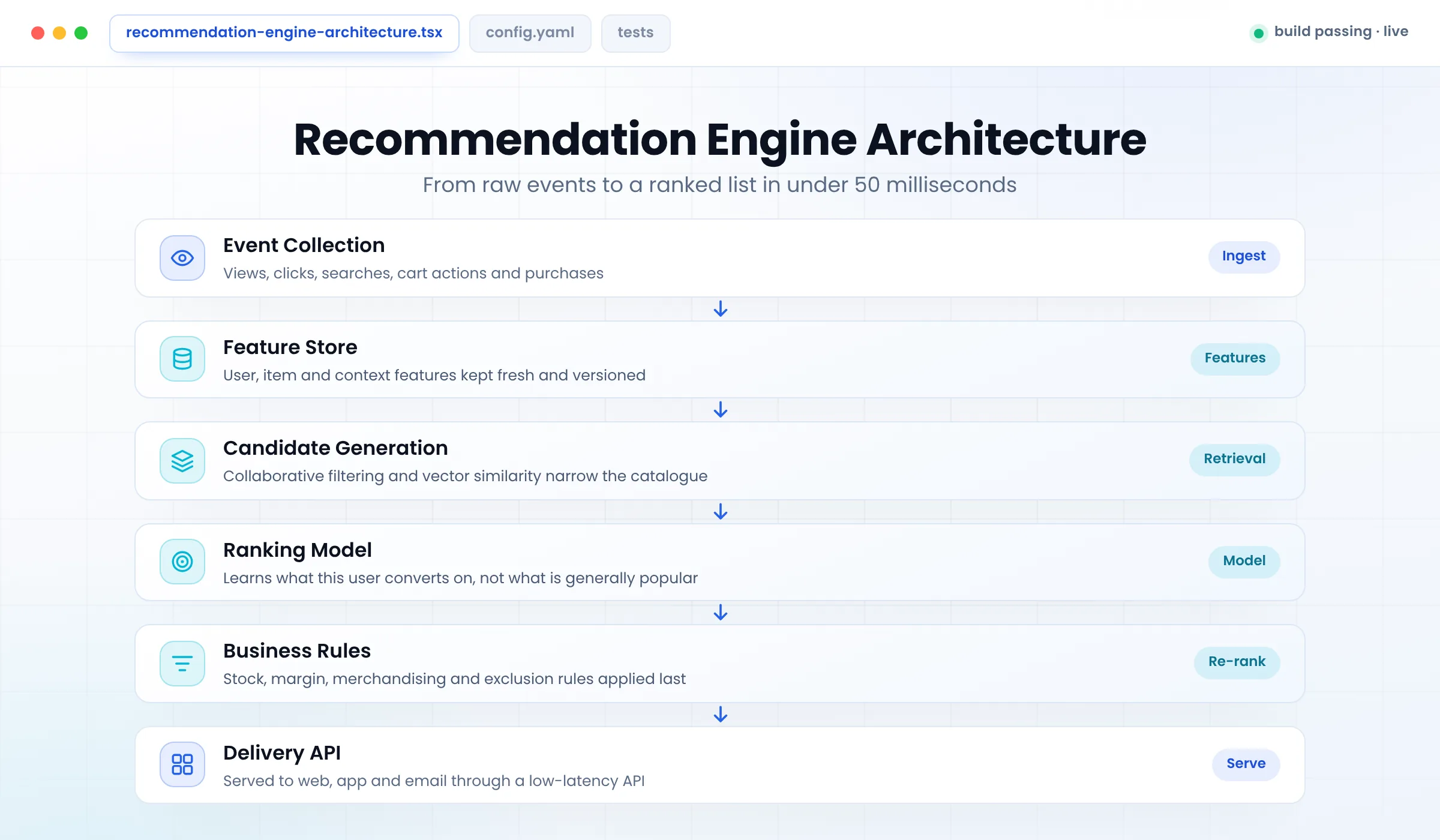
For larger workloads the architecture may also include batch processing, real-time event processing, model training pipelines, feature stores, caching, monitoring and experimentation infrastructure.
One engine can power several different parts of your digital product
Content, products or services relevant to each user’s interests.
Find relevant options without navigating a large catalog manually.
Items related to whatever the user is currently viewing.
Complementary products or services relevant to the current selection.
Surface articles, videos or courses from interaction and content data.
Recommendation signals alongside search to improve ranking.
Personalisation applied where it changes a business metric
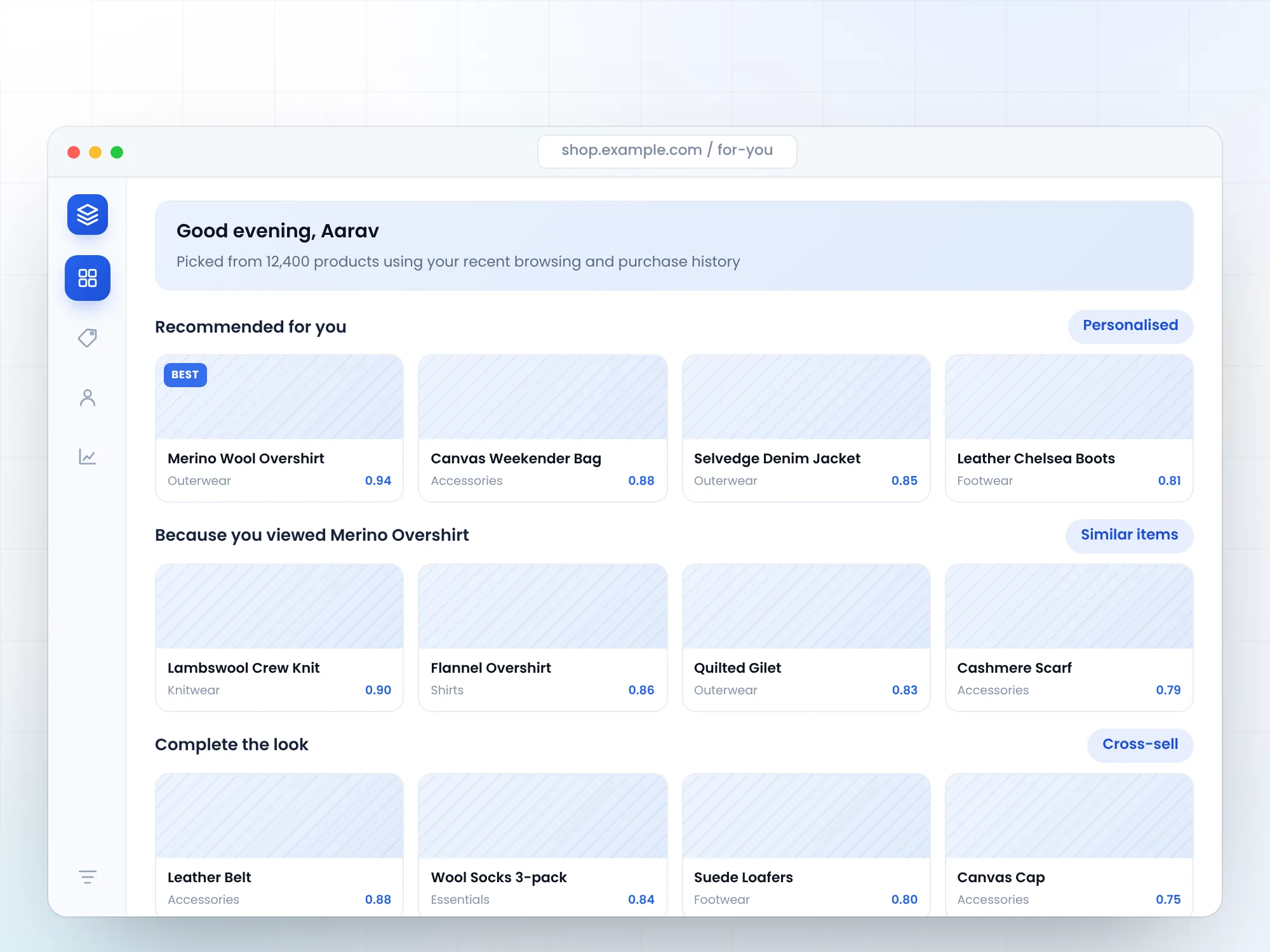
Recommend products from browsing behaviour, purchases and product relationships — recommended-for-you, similar products, frequently bought together and personalized offers across your ecommerce platform.
Recommend movies, shows, music or video from viewing and listening behaviour — continue watching, because you watched, and trending for you.
Recommend courses and learning resources from learner interests and activity — next course, related resources and skill paths.
Personalize features, content, workflows and resources from user activity — feature discovery, template suggestions and onboarding paths inside your SaaS product.
Help users discover relevant sellers, products, services and listings — listing relevance, seller matching and category discovery, often paired with multi-vendor marketplace development.
Recommend properties from preferences, characteristics, location and budget — matched properties, similar listings and saved-search alerts.
Personalize destinations, hotels, activities and travel services — destination picks, stay suggestions and activity bundles.
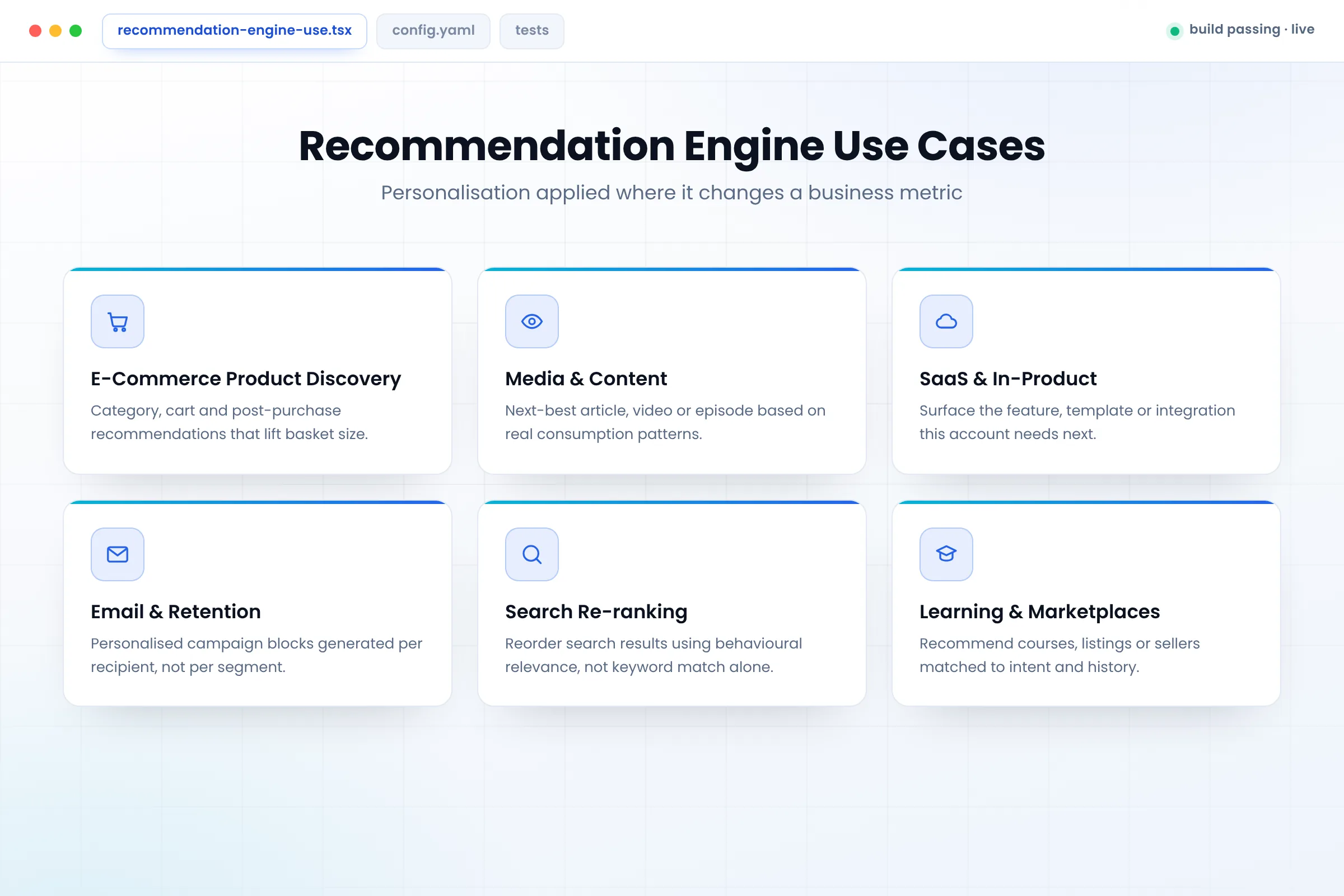
We combine AI development, software engineering, data engineering and application development, so the engine operates as part of a working product rather than an isolated machine learning component. Browse our portfolio and case studies for shipped examples.
The same engine, pointed at a different definition of relevance
Personalize product discovery and shopping experiences.
Help users discover relevant listings, sellers, products or services.
Personalize application experiences and surface relevant features.
Improve content discovery across large libraries.
Help learners discover relevant courses and resources.
Personalize destinations, properties, activities and services.
Embeddings, vector search, ranking models and your business rules in one serving path — items with similar characteristics sit close together in embedding space, ranking picks what this particular user is likely to engage with, and business rules are applied last.
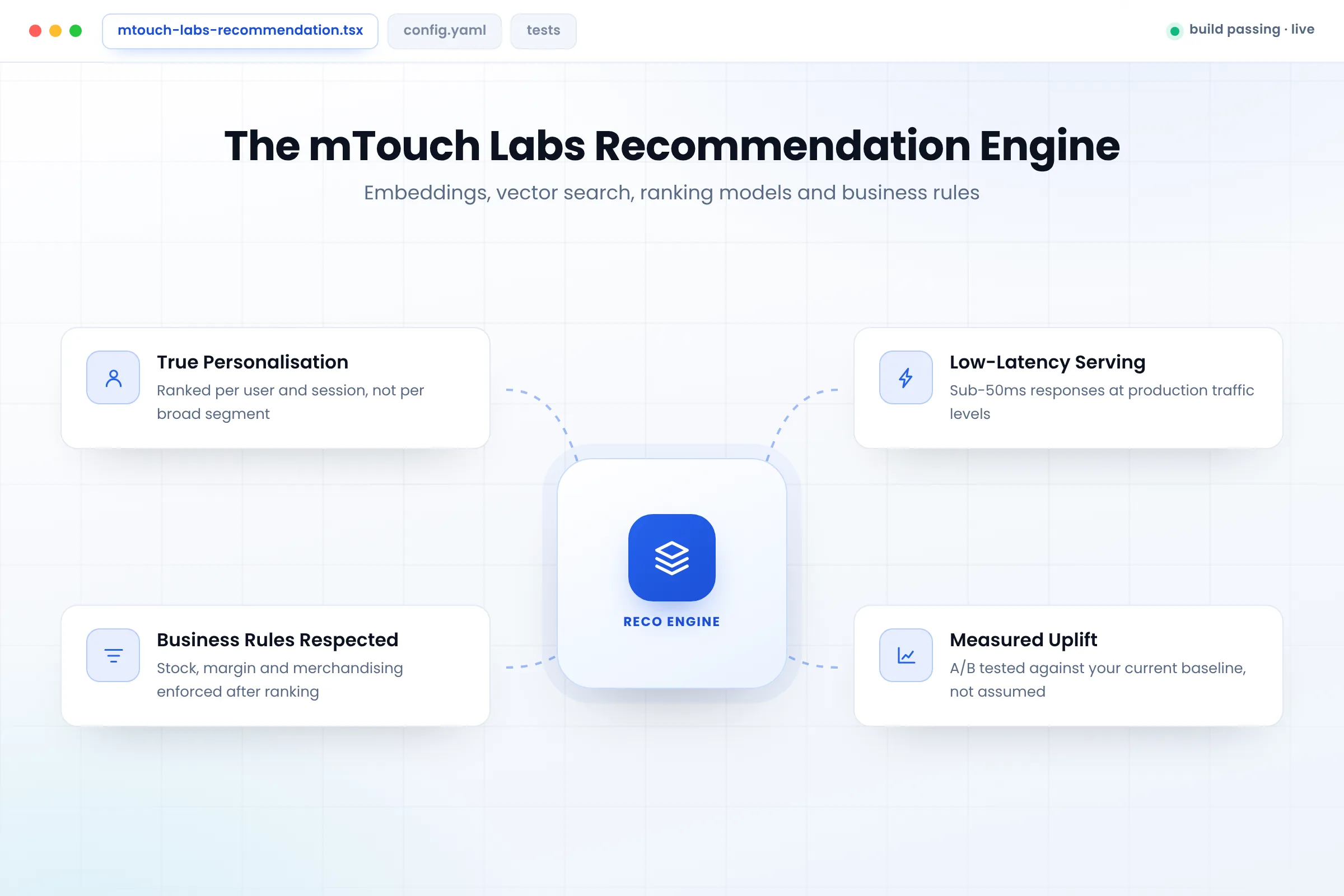
Selection depends on your data, scale, latency requirements, recommendation strategy and application architecture — not a fixed stack applied to every project.
Seven stages from data discovery through to ongoing optimization
Your recommendation goals, users, catalog, available interaction data, business rules and technical environment.
Which approaches suit your use case and the data you actually have.
Interaction, user, product, content and contextual data prepared for recommendation workflows.
Develop and evaluate the recommendation approach against the defined requirements.
Integrate recommendations into your website, mobile app, SaaS product or marketplace.
Recommendation quality, latency, relevance, coverage and defined business metrics.
Refine from observed performance, changing data, user behaviour and business requirements.
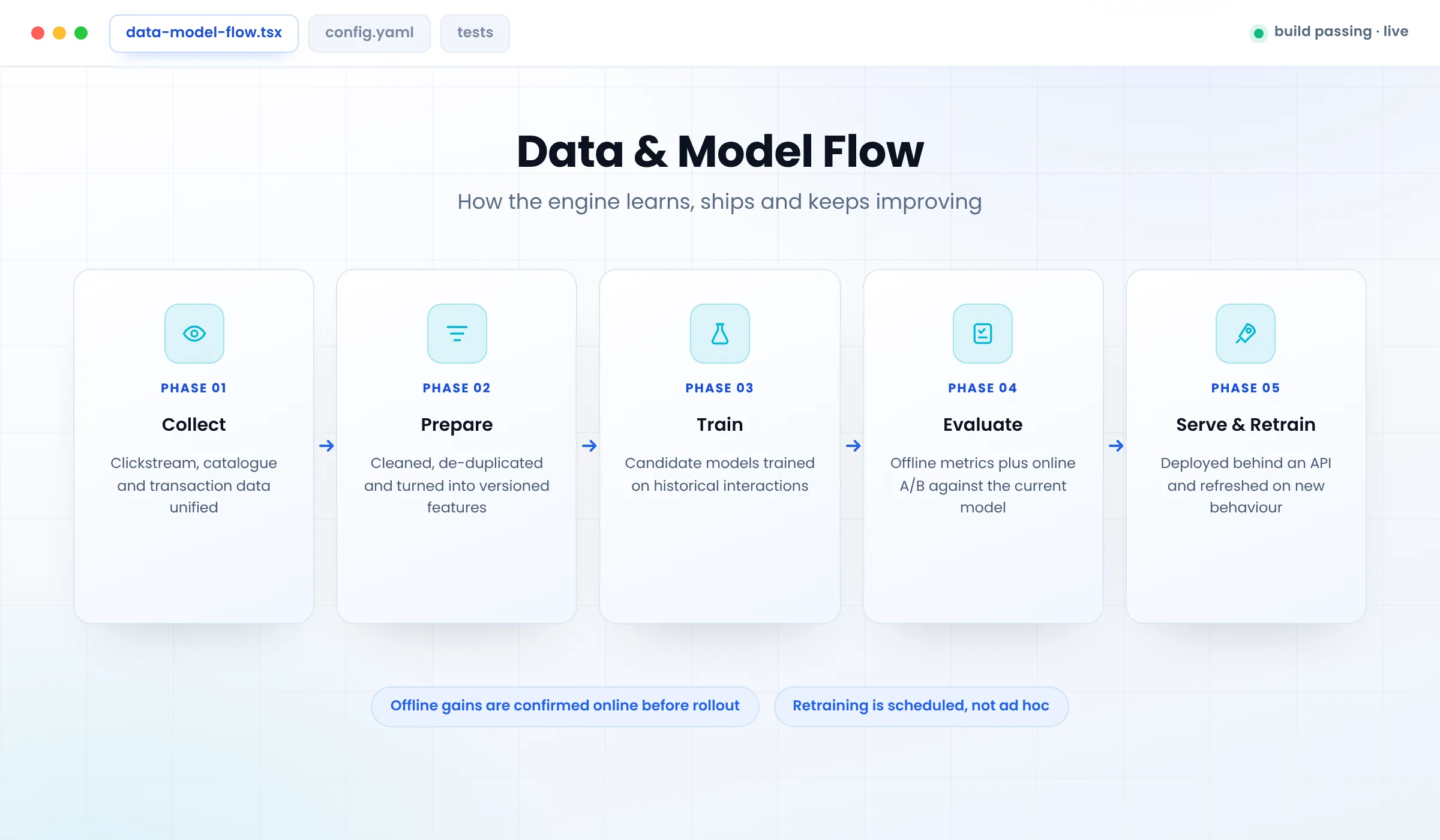
Available data should be evaluated carefully before selecting an architecture. More data does not automatically mean better recommendations — quality, relevance, freshness and coverage matter just as much.
Capabilities most often built alongside an AI recommendation engine
The ranking and propensity models behind personalised relevance.
LLM-powered applications, RAG pipelines and production AI automation.
Guided selling that uses recommendations inside a sales conversation.
Conversational discovery on top of the same catalogue signals.
The storefront the recommendation rails live inside.
In-product personalisation for your software platform.
Everything about AI recommendation engine development
An AI recommendation engine is a software system that analyzes available user, item, interaction, and contextual data to generate or rank personalized recommendations.
A recommendation system processes relevant data, generates potential recommendations, ranks them according to the selected approach, and delivers the results through an application or API.
The terms are often used interchangeably. An AI recommendation engine generally refers to the software component responsible for generating or ranking recommendations, while a recommendation system can refer to the broader architecture surrounding it.
Yes. mTouch Labs can develop custom product recommendation systems for e-commerce platforms, marketplaces, and other digital products.
Yes, where the application's architecture and data infrastructure support real-time processing. The appropriate approach depends on latency, event volume, model complexity, and business requirements.
Yes. Existing product, content, user, and interaction data can be evaluated and incorporated when it is suitable for the recommendation use case.
The cost depends on the recommendation approach, data volume, integrations, application complexity, infrastructure, real-time requirements, and expected scale.
Create more relevant digital experiences with an AI recommendation system designed around your users, products, content and business goals — for e-commerce, marketplaces, SaaS, media, education, travel and other digital platforms. Talk to mTouch Labs about your project.
 Chat with us!