




TL;DR — What You'll Learn
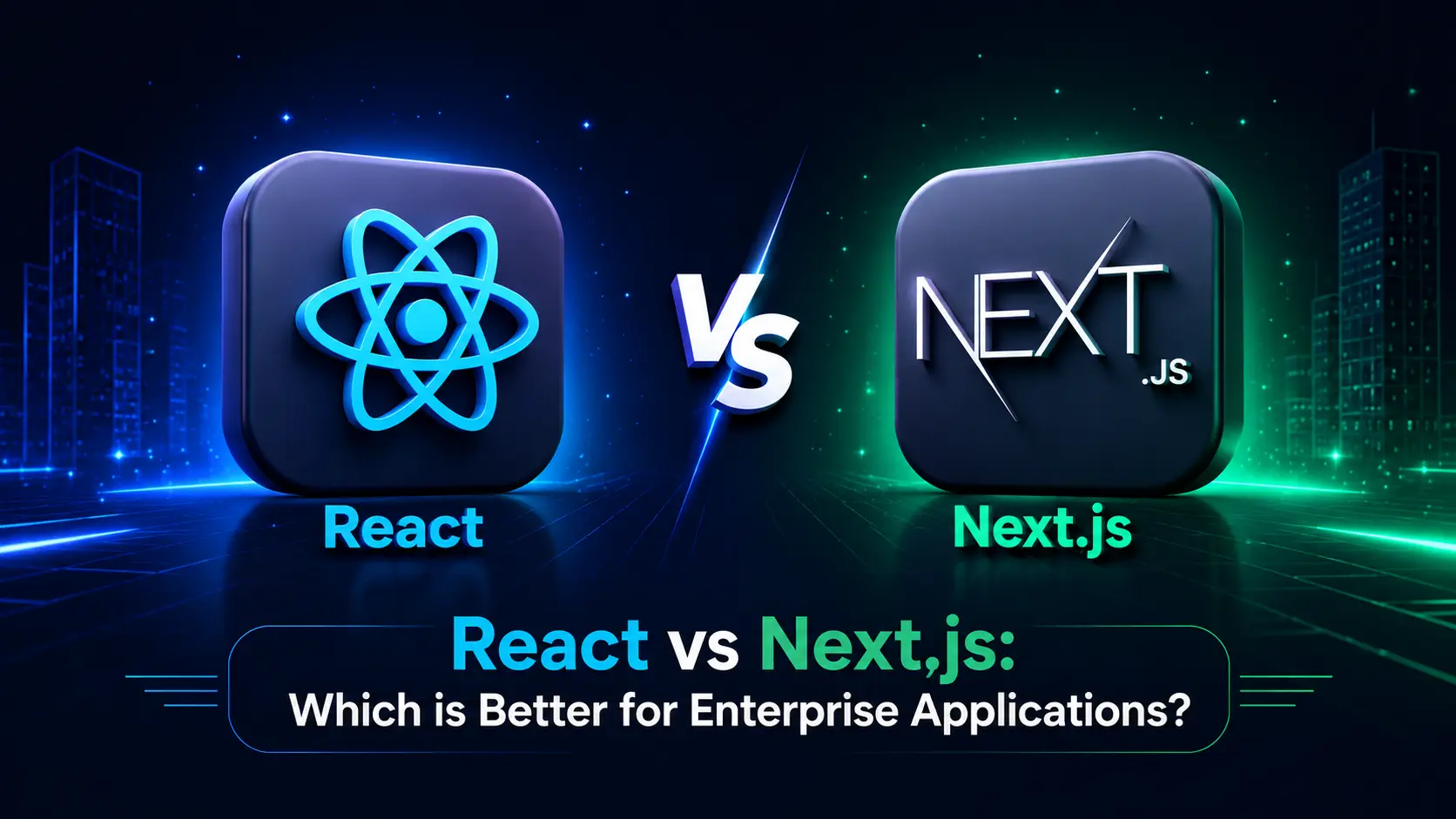
Compare React vs Next.js for enterprise applications. Learn the differences in performance, SEO, scalability, security, and choose the right frontend architecture.
Why Frontend Architecture Matters More Than Ever
Enterprise applications have evolved far beyond simple business websites. Today's organisations rely on digital platforms to manage operations, serve millions of users, integrate with multiple business systems, and deliver seamless experiences across devices. Whether it's an e-commerce platform, customer portal, healthcare system, financial application, or enterprise SaaS product, the frontend architecture plays a crucial role in determining long-term success.
For enterprise organisations, choosing a frontend technology isn't simply a developer preference—it is a strategic business decision. The right technology influences application performance, scalability, search visibility, security, development efficiency, maintenance costs, and the ability to adapt to future business requirements. This is why many organisations involve an experienced software development company at the architecture stage.
Among modern frontend technologies, React and Next.js are two of the most widely discussed options. While they are closely related, they serve different purposes and are designed to solve different challenges. Understanding these differences is essential before making a technology investment.
This guide explores React and Next.js from an enterprise perspective, helping CTOs, product managers, business leaders, and development teams determine which approach best supports their digital transformation goals.
Quick Answer
React and Next.js are not direct competitors—they complement each other. React is a JavaScript library for building interactive user interfaces, while Next.js is a full-stack framework built on React that adds features such as server-side rendering, static site generation, routing, image optimisation, and performance enhancements.
For enterprise applications, the better choice depends on business requirements:
- Choose React when building highly interactive internal applications, dashboards, or single-page applications where search engine visibility is not a primary concern.
- Choose Next.js for customer-facing platforms, enterprise websites, SaaS products, e-commerce solutions, and applications that require excellent SEO, faster page loading, and improved scalability.
Organisations can also combine both approaches, using React where rich client-side interactivity is needed and Next.js where performance, discoverability, and user experience are business priorities.
Rather than asking "Which is better?", enterprise teams should ask "Which architecture best supports our business objectives?"
Why Enterprises Compare React and Next.js
Technology decisions become increasingly important as applications grow in complexity.
An enterprise platform may need to:
- Support thousands or even millions of users.
- Deliver fast experiences across different regions.
- Integrate with ERP, CRM, payment gateways, identity providers, and cloud services.
- Protect sensitive customer and business data.
- Scale efficiently as traffic increases.
- Maintain high availability with minimal downtime.
- Support continuous feature releases without disrupting users.
Choosing the wrong frontend architecture can result in slower performance, higher infrastructure costs, difficult maintenance, and expensive redevelopment in the future.
React and Next.js are both capable technologies, but they solve enterprise challenges differently. Comparing them early in the planning stage helps organisations avoid costly architectural decisions later.
The Enterprise Challenges Modern Applications Must Solve
Enterprise software is expected to deliver far more than attractive user interfaces. It must support business growth while maintaining reliability, security, and operational efficiency.
Some of the most common challenges include:
Delivering Exceptional Performance
Users expect web applications to load quickly regardless of their device or network speed. Even small delays can affect customer satisfaction, user engagement, and conversion rates.
A modern frontend architecture should minimise loading times, optimise asset delivery, and provide responsive interactions across different environments.
Supporting Business Growth
Applications that serve a few thousand users today may need to support millions tomorrow.
Enterprise platforms should be designed with scalability in mind, allowing infrastructure and application architecture to grow alongside business demand without requiring complete redevelopment.
Improving Search Visibility
For customer-facing platforms, search engines remain a major source of traffic.
Marketing websites, SaaS products, documentation portals, and e-commerce platforms benefit from architectures that make content easily discoverable while maintaining fast page performance.
Strong search visibility also contributes to brand credibility and customer acquisition.
Simplifying Long-Term Maintenance
Enterprise applications often remain in production for many years.
Development teams require technologies that support modular architecture, reusable components, predictable updates, and efficient collaboration between multiple engineering teams.
Maintainability directly impacts long-term development costs and release cycles.
Strengthening Security
Security is a fundamental requirement for enterprise software.
Applications handling customer information, financial transactions, healthcare records, or confidential business data must implement secure authentication, access controls, encrypted communications, and protection against common web vulnerabilities.
Frontend architecture should support these security objectives rather than complicate them.
Enhancing Developer Productivity
Modern enterprises frequently have multiple development teams working simultaneously on different features.
Choosing technologies with mature ecosystems, strong documentation, and efficient development workflows enables faster delivery, easier onboarding, and improved collaboration.
Developer productivity has a direct impact on project timelines and overall return on investment.
React and Next.js: Different Approaches to Enterprise Development
Many businesses assume React and Next.js are competing technologies.
In reality, they have a parent-child relationship.
React provides the foundation for building reusable user interface components. It focuses primarily on the presentation layer, giving developers flexibility to choose routing, rendering strategies, state management, and additional libraries based on project needs.
Next.js builds on React by providing an opinionated framework that includes many enterprise-ready capabilities out of the box. Features such as server-side rendering, file-based routing, image optimisation, API routes, incremental static regeneration, and modern rendering options reduce the amount of custom configuration required for large-scale applications.
Because of this relationship, the decision is not about choosing one technology over another. It is about determining whether a lightweight UI library or a complete application framework better aligns with the goals of your enterprise project. Specialist frontend development services can help make that call objectively.
Questions Every Enterprise Team Should Ask
Before selecting a frontend technology, business and technical stakeholders should evaluate questions such as:
- Will the application be public-facing or used only within the organisation?
- Is search engine visibility an important business objective?
- How critical are page speed and Core Web Vitals?
- Will the application serve users globally?
- How often will content change?
- Does the project require server-side rendering or static generation?
- What are the long-term maintenance expectations?
- What skills already exist within the development team?
- How important is rapid scalability over the next three to five years?
Answering these questions provides far more value than comparing technologies based solely on popularity or feature lists.
React vs Next.js: Understanding the Technologies Beyond the Hype
After identifying the business challenges enterprises face, the next step is understanding what React and Next.js actually bring to a project. Although they are often compared as competing technologies, they solve different problems within the application development lifecycle.
React provides the foundation for building dynamic user interfaces, while Next.js extends React with capabilities designed to simplify application architecture and improve performance. Understanding how they work—and how those differences affect enterprise applications—is far more valuable than simply comparing feature lists.
React: A Flexible Foundation for Modern Web Applications
React, developed and maintained by Meta, is one of the most widely adopted JavaScript libraries for building user interfaces. Its popularity comes from its flexibility, reusable component model, and extensive ecosystem.
Unlike a complete application framework, React focuses primarily on the presentation layer. Developers have the freedom to choose additional tools for routing, state management, authentication, API communication, testing, and deployment based on project requirements.
For enterprises, this flexibility can be both a strength and a responsibility. Engaging a dedicated React development company helps turn that flexibility into a maintainable architecture.
What Makes React Popular?
React introduced a component-based architecture that allows developers to build applications using reusable building blocks. Instead of recreating similar interface elements across different pages, teams can develop reusable components that improve consistency and reduce maintenance effort.
For large enterprise projects, this means:
- Better code reusability
- Easier collaboration across development teams
- Faster feature development
- Improved maintainability
- Consistent user experiences
As applications grow, these benefits become increasingly valuable.
React's Client-Side Rendering Approach
By default, React applications render content in the user's browser through Client-Side Rendering (CSR).
The browser first downloads the application's JavaScript files before displaying the interface.
This approach offers several advantages:
- Highly interactive user experiences
- Smooth navigation between pages
- Reduced server workload after the initial load
- Excellent support for real-time applications
Applications such as dashboards, project management tools, CRM platforms, analytics portals, and internal business systems often benefit from client-side rendering because users interact continuously with dynamic content.
However, relying entirely on client-side rendering may introduce challenges for customer-facing platforms that depend on search engine visibility or require very fast initial page loads.
Where React Fits Best in Enterprise Projects
React continues to be an excellent choice for enterprise applications where interactivity is more important than search engine optimisation.
Typical use cases include:
- Employee portals
- Internal ERP systems
- Financial dashboards
- HR management platforms
- Business intelligence applications
- Manufacturing control systems
- Inventory management software
- Real-time monitoring platforms
These applications prioritise authenticated users, rich interactions, and continuous data updates rather than organic search traffic.
Next.js: Extending React for Enterprise-Scale Applications
Next.js is a React framework developed by Vercel that addresses many architectural challenges encountered in large-scale web applications.
Rather than replacing React, Next.js builds on top of it by introducing conventions and built-in capabilities that reduce development complexity.
Instead of assembling multiple third-party libraries for routing, rendering, optimisation, and backend functionality, development teams receive these capabilities as part of the framework.
This approach improves consistency while reducing configuration effort. Our Next.js development company services apply these conventions to enterprise-scale builds.
Rendering Strategies That Support Different Business Needs
One of Next.js's greatest strengths is its support for multiple rendering methods. Rather than forcing every page to behave the same way, enterprises can choose the rendering strategy that best suits each type of content.
Server-Side Rendering (SSR)
With Server-Side Rendering, HTML is generated on the server whenever a user requests a page.
This approach is particularly useful for:
- Customer portals
- Dynamic product catalogues
- Personalised dashboards
- Frequently changing content
- Enterprise SaaS platforms
Because users receive pre-rendered HTML, pages become visible more quickly and are easier for search engines to crawl.
Static Site Generation (SSG)
Static Site Generation creates pages during the build process.
These pages are then served almost instantly from a content delivery network.
SSG works exceptionally well for:
- Corporate websites
- Landing pages
- Product pages
- Documentation
- Knowledge bases
- Marketing websites
Since content is generated in advance, performance and reliability improve significantly.
Incremental Static Regeneration (ISR)
Enterprise websites often contain information that changes periodically rather than every second.
Incremental Static Regeneration allows pages to remain static while updating automatically in the background after a specified interval.
This reduces server workload while ensuring visitors receive fresh content.
Examples include:
- Blog articles
- Industry reports
- Service pages
- Case studies
- Resource libraries
Server Components
Modern enterprise applications increasingly separate server-side processing from client-side interactions.
React Server Components, supported by Next.js, enable portions of an application to execute on the server, reducing the amount of JavaScript delivered to users.
The result is:
- Faster page loads
- Lower bandwidth consumption
- Improved scalability
- Better Core Web Vitals
- Enhanced user experience
This capability is particularly valuable for content-heavy enterprise platforms.
Enterprise Features Available Out of the Box
One of the biggest differences between React and Next.js is the amount of infrastructure developers need to build themselves.
React offers maximum flexibility but requires additional libraries and configuration for many common requirements.
Next.js includes several enterprise-ready features by default, including:
- File-based routing
- Image optimisation
- Font optimisation
- API routes
- Middleware
- Edge Runtime support
- Built-in performance optimisation
- Metadata management
- Streaming support
- Advanced caching capabilities
These features reduce development effort while promoting consistent architectural patterns across large teams.
React vs Next.js: Architectural Philosophy
Although both technologies share the same foundation, their philosophies differ.
React encourages developers to build exactly what they need by selecting their preferred libraries and tools.
This flexibility is valuable for organisations with highly specialised technical requirements or established frontend ecosystems.
Next.js, on the other hand, embraces convention over configuration. It provides a structured development environment with recommended patterns for routing, rendering, optimisation, and deployment.
For enterprise teams, this often leads to:
- Faster project setup
- More predictable codebases
- Easier onboarding
- Simplified maintenance
- Reduced architectural inconsistency
Neither philosophy is universally better—the right choice depends on the complexity and objectives of the project.
How These Differences Affect Enterprise Development
When viewed from a business perspective, the distinction between React and Next.js becomes clearer.
If an organisation is building an internal application where users authenticate before accessing highly interactive features, React's flexibility may be sufficient.
If the application is customer-facing, requires excellent search visibility, or must deliver fast experiences across global markets, Next.js provides additional capabilities that can reduce development effort and improve performance.
The decision is therefore less about technical superiority and more about selecting an architecture that aligns with business priorities.
Looking Beyond Technology Choices
Enterprise success is rarely determined by a single framework.
Scalable architecture, secure development practices, efficient DevOps pipelines, automated testing, cloud infrastructure, monitoring, and experienced engineering teams all contribute to long-term success. Mature cloud and DevOps services are as decisive as the framework itself.
React and Next.js should be viewed as components of a broader technology strategy rather than standalone solutions.
In the next section, we'll evaluate how both technologies perform across real-world enterprise scenarios, including SaaS platforms, banking systems, healthcare applications, e-commerce solutions, internal business tools, and large-scale digital platforms. Instead of theoretical comparisons, we'll examine which option delivers the greatest value for specific business requirements.
React vs Next.js in Real Enterprise Scenarios
Choosing between React and Next.js becomes much easier when the discussion moves beyond technical specifications and focuses on real business requirements. Every enterprise application has different objectives, users, compliance requirements, and growth expectations.
Instead of asking which technology is better overall, enterprise teams should evaluate which solution aligns best with their specific use case.
The following scenarios illustrate how React and Next.js fit into different enterprise environments.
Enterprise SaaS Platforms
Software-as-a-Service (SaaS) products often serve thousands of customers across multiple regions. Users expect applications to load quickly, remain responsive, and scale seamlessly as new features are introduced.
A typical SaaS platform includes:
- Marketing website
- Customer onboarding
- Authentication
- User dashboards
- Billing portals
- Documentation
- Admin panels
- Analytics
In these environments, both React and Next.js can play complementary roles.
The marketing website, pricing pages, documentation, and public resources benefit significantly from Next.js because they require fast loading, search engine visibility, and excellent Core Web Vitals.
Once users authenticate, highly interactive dashboards and account management features can leverage React's client-side capabilities for a smooth application experience.
Many successful SaaS companies adopt this hybrid architecture rather than relying exclusively on a single rendering strategy, often delivered through SaaS application development engagements.
Enterprise Resource Planning (ERP) Systems
ERP systems manage critical business operations such as finance, procurement, inventory, manufacturing, payroll, and supply chain management.
These applications are primarily used by authenticated employees rather than public visitors.
Key priorities include:
- Fast internal workflows
- Real-time data
- Complex dashboards
- Secure access
- Integration with multiple enterprise systems
Since SEO is rarely a concern, React provides an excellent foundation for these highly interactive environments.
However, organisations developing customer-facing ERP portals or supplier portals may incorporate Next.js for those specific modules to improve initial loading performance and user experience.
Banking and Financial Applications
Financial institutions operate under strict regulatory requirements while handling sensitive customer information and high transaction volumes.
Their digital platforms typically include:
- Online banking
- Investment portals
- Loan management
- Insurance services
- Payment gateways
- Financial dashboards
Performance and security are equally important.
Public-facing pages such as financial products, calculators, and educational resources benefit from Next.js because they require discoverability and rapid page delivery.
Secure customer portals often rely on React for highly interactive account management experiences.
Rather than selecting one framework for the entire ecosystem, enterprise banks frequently separate public content from authenticated applications based on business requirements.
Healthcare Platforms
Healthcare organisations require systems that deliver reliable performance while protecting sensitive patient information.
Common healthcare applications include:
- Patient portals
- Appointment scheduling
- Telemedicine platforms
- Electronic health records
- Hospital management systems
- Healthcare analytics
Patient education pages and hospital websites benefit from Next.js due to improved search visibility and performance.
Meanwhile, medical professionals working with patient records often require highly interactive dashboards where React provides an efficient development model.
Security, compliance, and accessibility remain significantly more important than framework selection alone.
E-commerce Platforms
Modern e-commerce platforms compete heavily on speed, search visibility, and customer experience.
Customers expect:
- Fast product searches
- Instant page loads
- Personalised recommendations
- Smooth checkout experiences
- Mobile responsiveness
For these businesses, Next.js offers significant advantages.
Features such as server-side rendering, static generation, image optimisation, and improved Core Web Vitals help enhance product discoverability while reducing page loading times.
React continues to power dynamic shopping experiences including:
- Shopping carts
- Product configurators
- Checkout workflows
- Customer accounts
- Wishlist management
Combining both technologies enables retailers to optimise both acquisition and user engagement.
Government and Public Sector Platforms
Government websites serve large and diverse audiences with varying internet speeds and accessibility needs.
These platforms frequently publish:
- Public services
- Citizen portals
- Tax information
- Application forms
- Digital documents
- Policy updates
Accessibility, reliability, and performance become mandatory requirements.
Next.js is particularly valuable for delivering content quickly while supporting search engine indexing and improved user experience.
Interactive citizen dashboards or authenticated employee systems may continue using React where extensive client-side functionality is required.
Enterprise Content Platforms
Large organisations often operate extensive content ecosystems that include:
- Corporate websites
- Knowledge centres
- Documentation portals
- Help centres
- Blogs
- Product documentation
These websites continuously publish new content while maintaining high traffic volumes.
Next.js is especially well suited because it supports:
- Static Site Generation
- Incremental Static Regeneration
- Fast content delivery
- Excellent SEO
- Global CDN deployment
These capabilities improve both customer experience and operational efficiency.
AI-Powered Enterprise Applications
Artificial Intelligence is becoming a core component of enterprise software.
Modern AI applications include:
- Intelligent assistants
- AI-powered search
- Document summarisation
- Workflow automation
- Recommendation engines
- Predictive analytics
These applications combine interactive interfaces with complex backend processing.
React delivers responsive user interactions, while Next.js improves application performance by reducing unnecessary client-side processing and supporting server-side execution where appropriate.
For AI-driven SaaS platforms, this combination often produces an optimal balance between responsiveness and scalability. A generative AI development company can help design the backend that sits behind it.
Performance at Enterprise Scale
As enterprise applications expand, maintaining performance becomes increasingly challenging.
Growing user bases, larger datasets, and additional integrations place continuous demands on frontend architecture.
React provides exceptional responsiveness after the application loads, making it highly effective for dynamic business workflows.
Next.js focuses on improving the entire user journey by optimising:
- Initial page rendering
- Asset loading
- Image delivery
- Caching strategies
- Streaming
- Server-side rendering
- Content distribution
For organisations prioritising customer acquisition and user experience, these optimisations can have a measurable business impact.
Scalability Beyond Infrastructure
Enterprise scalability extends beyond handling additional users.
Applications must also support:
- Multiple development teams
- New business units
- International expansion
- Additional product lines
- Continuous feature releases
- Independent deployment cycles
React's component-based architecture supports modular development, allowing teams to reuse functionality across multiple applications.
Next.js builds on this by providing consistent architectural conventions that simplify collaboration between distributed engineering teams.
As organisations scale, predictable development patterns become increasingly valuable.
Security and Compliance
Security considerations should influence technology decisions from the earliest planning stages.
Enterprise applications commonly require:
- Secure authentication
- Single Sign-On (SSO)
- Role-Based Access Control (RBAC)
- Data encryption
- Audit logging
- Compliance with regulations such as GDPR, HIPAA, or PCI DSS
- Protection against common web vulnerabilities
Neither React nor Next.js guarantees security by itself.
Instead, enterprise security depends on secure coding practices, robust authentication, API protection, infrastructure hardening, continuous monitoring, and regular security testing.
Next.js can simplify implementation of certain security controls through middleware and server-side capabilities, while React offers flexibility for organisations with established security architectures.
Decision Matrix: Which Technology Fits Your Enterprise?
| Enterprise Requirement | Recommended Choice | Reason |
|---|---|---|
| Internal ERP System | React | Rich client-side interactions and authenticated users |
| Corporate Website | Next.js | SEO, performance, and fast page delivery |
| SaaS Marketing Website | Next.js | Better discoverability and Core Web Vitals |
| SaaS Dashboard | React | Highly interactive user experience |
| E-commerce Store | Next.js | Faster product pages and improved search visibility |
| Customer Portal | Next.js | Better initial loading with scalable rendering |
| Banking Dashboard | React | Complex authenticated workflows |
| Healthcare Portal | Next.js | Public information and patient accessibility |
| AI Business Platform | React + Next.js | Combines interactivity with enterprise performance |
| Enterprise Knowledge Base | Next.js | Static generation and rapid content delivery |
The Best Enterprise Choice Is Often Both
One of the biggest misconceptions is believing that enterprises must choose either React or Next.js for every application.
Modern enterprise architecture rarely works this way.
Many organisations successfully use both technologies within the same ecosystem.
For example:
- Public website → Next.js
- Product documentation → Next.js
- Customer onboarding → Next.js
- Internal admin portal → React
- Analytics dashboard → React
- Business intelligence platform → React
This hybrid approach allows each technology to solve the problems it handles best while maintaining a consistent development experience through the shared React ecosystem.
Migration Strategies, Enterprise Best Practices, and the Final Decision Framework
Selecting the right frontend technology is only one part of building a successful enterprise application. Long-term success depends on how well the technology is implemented, maintained, and evolved as business requirements change.
Many organisations already have React applications in production, while others are planning entirely new digital platforms. Understanding when to migrate, how to minimise risk, and which best practices to follow can significantly reduce development costs and improve project outcomes.
When React Is the Right Choice
React remains an excellent solution for many enterprise projects. Choosing Next.js simply because it is newer or more popular does not always create additional business value.
React is often the better choice when your application:
- Is used only by authenticated employees.
- Functions as a Single Page Application (SPA).
- Requires extensive real-time interactions.
- Depends heavily on WebSockets or live data.
- Prioritises rich client-side experiences over search engine visibility.
- Already has a mature React ecosystem with stable architecture.
Examples include:
- ERP systems
- HRMS platforms
- CRM applications
- Analytics dashboards
- Manufacturing systems
- Internal administration portals
For these applications, React offers flexibility while keeping development efficient.
When Next.js Becomes the Better Investment
Next.js is particularly valuable when business growth depends on visibility, performance, and scalability.
Choose Next.js if your application includes:
- Marketing websites
- Enterprise product pages
- Customer portals
- SaaS landing pages
- E-commerce storefronts
- Documentation websites
- Public knowledge bases
- Multi-language websites
These applications benefit from:
- Better SEO
- Faster first-page load
- Improved Core Web Vitals
- Enhanced user experience
- Better content discoverability
- Simplified performance optimisation
For customer acquisition, these advantages often translate into measurable business outcomes.
Should Existing React Applications Be Migrated?
One of the most common questions enterprises ask is whether they should migrate an existing React application to Next.js.
The answer depends on business goals rather than technology trends.
Migration is worth considering when:
- Organic search traffic is important.
- Performance has become a business concern.
- Initial page load times are affecting user experience.
- Multiple optimisation libraries are increasing maintenance complexity.
- The application includes significant public-facing content.
- Future scalability requires modern rendering strategies.
Migration may not be necessary when:
- The application is entirely internal.
- Current performance meets business expectations.
- SEO provides little or no value.
- Existing architecture is stable and maintainable.
- Migration costs outweigh expected business benefits.
Technology upgrades should always be justified by measurable business value.
Practical Migration Strategy
Migrating enterprise applications should never involve rewriting the entire system at once.
A phased migration approach reduces risk and allows continuous business operations.
Step 1: Evaluate Existing Architecture
Identify:
- Current routing
- State management
- API structure
- Authentication
- Shared components
- Performance bottlenecks
This assessment determines which parts of the application require improvement.
Step 2: Separate Public and Internal Experiences
Many enterprises successfully migrate only customer-facing modules.
Examples include:
- Corporate website
- Landing pages
- Blog
- Documentation
- Customer onboarding
Internal dashboards can continue running on React if they already perform well.
Step 3: Migrate High-Impact Pages First
Prioritise pages that influence:
- SEO
- Conversion rates
- Customer acquisition
- Marketing campaigns
- Product discovery
These pages usually deliver the fastest return on investment.
Step 4: Optimise Performance
After migration, focus on:
- Image optimisation
- Code splitting
- Lazy loading
- Caching strategies
- CDN delivery
- Bundle size reduction
Performance optimisation should be an ongoing process rather than a one-time task.
Common Mistakes Enterprise Teams Make
Technology decisions sometimes fail because organisations focus on trends instead of business requirements.
Avoid these common mistakes:
Choosing Technology Based on Popularity
The most popular framework is not always the best solution.
Business objectives should guide architectural decisions.
Ignoring Long-Term Maintenance
Projects often succeed initially but become difficult to maintain because architecture was not planned for future growth.
Maintainability is just as important as initial development speed.
Overlooking Performance Early
Performance should be considered during architecture planning—not after deployment.
Optimising a poorly designed application later is usually more expensive.
Treating SEO as a Marketing Problem
SEO begins with technical architecture.
Rendering strategy, page speed, structured metadata, and accessibility all influence search performance.
Development and marketing teams should collaborate from the beginning.
Underestimating Scalability
Applications evolve.
Building with future expansion in mind reduces redevelopment costs and supports long-term business growth.
Enterprise Best Practices
Successful enterprise projects typically share several characteristics regardless of whether they use React or Next.js.
Build Modular Architectures
Reusable components reduce duplication and simplify future enhancements.
Prioritise Performance Budgets
Define acceptable limits for:
- JavaScript bundle size
- Image sizes
- API response times
- Initial page load
- Core Web Vitals
Monitoring these metrics helps maintain application quality over time.
Automate Testing
Comprehensive testing should include:
- Unit testing
- Integration testing
- End-to-end testing
- Accessibility testing
- Performance testing
Automation improves release confidence while reducing manual effort.
Secure Applications by Design
Security should be integrated throughout the development lifecycle.
Best practices include:
- Secure authentication
- Multi-Factor Authentication (MFA)
- Role-Based Access Control (RBAC)
- API validation
- HTTPS enforcement
- Dependency management
- Regular security audits
Plan for Continuous Improvement
Enterprise applications are never truly finished.
Continuous optimisation based on analytics, user feedback, and evolving business requirements keeps applications competitive, supported by ongoing application maintenance and support.
The Future of Enterprise Frontend Development
Frontend development continues to evolve rapidly.
Emerging trends include:
- AI-assisted development
- Edge computing
- Partial prerendering
- Server Components
- Streaming interfaces
- Intelligent caching
- Headless architectures
- Composable enterprise platforms
React and Next.js are both actively evolving to support these innovations, making them strong choices for future-ready enterprise applications and broader digital transformation initiatives.
Decision Checklist for CTOs and Product Teams
Before selecting a frontend technology, consider the following questions:
- Is the application public-facing?
- Does organic search traffic matter?
- Will content change frequently?
- Are fast initial page loads critical?
- Does the application require extensive client-side interactivity?
- Will multiple development teams contribute?
- Is global scalability a priority?
- What expertise already exists within the organisation?
- What is the expected lifespan of the application?
- Which option delivers the greatest long-term business value?
Answering these questions often provides a clearer direction than comparing individual framework features.
Why Choose mTouch Labs for Enterprise Web Development?
At mTouch Labs, we help organisations build scalable, secure, and high-performing enterprise web applications tailored to their business objectives.
Our expertise includes:
- Enterprise web application development
- React development
- Next.js development
- Custom software development
- UI/UX design
- API development and integration
- Cloud deployment and DevOps
- AI-powered application development
- Performance optimisation
- Application modernisation and maintenance
Rather than recommending a technology based on industry trends, we evaluate your business goals, technical requirements, existing systems, and future growth plans to design an architecture that delivers long-term value. Explore our case studies, the industries we serve, or learn more about mTouch Labs.
Whether you're launching a new SaaS platform, modernising a legacy application, or building a customer-facing enterprise solution, our team helps you choose and implement the right frontend strategy with confidence.
Key Takeaways
- React and Next.js serve different purposes within the same ecosystem.
- React is ideal for highly interactive, authenticated enterprise applications.
- Next.js excels in customer-facing platforms where SEO and performance are business priorities.
- Many enterprises achieve the best results by combining both technologies.
- Migration should be driven by measurable business goals rather than technology trends.
- Scalability, security, maintainability, and developer productivity should all influence architectural decisions.
Final Thoughts
The debate between React and Next.js isn't about identifying a universal winner—it's about selecting the right tool for the right business challenge.
React continues to be a powerful choice for interactive enterprise applications, while Next.js enhances React with capabilities that address the demands of modern customer-facing platforms. For many organisations, the most effective strategy is not choosing one over the other but using each where it delivers the greatest value.
By aligning frontend architecture with business objectives, performance expectations, scalability requirements, and long-term maintenance plans, enterprises can build digital platforms that remain reliable, adaptable, and competitive for years to come. Contact us to discuss your project, or request a free quote.
Frequently Asked Questions
What is the difference between React and Next.js?
Which is better for enterprise applications: React or Next.js?
Is Next.js replacing React?
Can React and Next.js be used together in the same enterprise project?
Is Next.js better than React for SEO?
Should I migrate my existing React application to Next.js?
Which framework offers better performance for enterprise web applications?
Is React still a good choice for enterprise development in 2026?
How do I choose between React and Next.js for my business?
Why choose mTouch Labs for React and Next.js development?
🎯 Key Takeaways
Compare React vs Next.js for enterprise applications. Learn the differences in performance, SEO, scalability, security, and choose the right frontend architecture.