




TL;DR — What You'll Learn
Learn how MVP development helps startups and businesses validate ideas, reduce initial scope, gather user feedback, and build smarter digital products.
Quick Answer
What is MVP development?
MVP development is the process of creating a focused first version of a digital product with enough functionality to solve a core user problem and test important product assumptions with real users. The objective is not to build a low-quality product or launch every planned feature. It is to create a useful initial experience, learn from actual users, and use that evidence to guide future development.
A well-planned MVP helps businesses reduce unnecessary initial development, validate product-market assumptions earlier, and make better decisions about what to build next.
Introduction
A product idea can look very different on a whiteboard than it does in the hands of a real customer.
During planning, teams may identify dozens of useful features, map detailed workflows, and imagine how users will interact with the finished product. But until people actually use the product, many important assumptions remain untested.
- Will customers understand the product?
- Will they use the main feature?
- Which part of the experience matters most?
- Will they return?
- Will they pay?
These questions are difficult to answer through planning alone.
This is where MVP development becomes valuable.
A Minimum Viable Product provides a focused way to take a product idea into the real world without immediately building the complete long-term vision.
The goal isn't simply to build faster.
It is to learn faster without making unnecessary development commitments.
At mTouch Labs, we approach MVP development and broader software development services with this principle in mind: understand the business objective first, identify the core user problem, define the smallest useful product, and create a foundation that can evolve as real-world feedback becomes available.
An MVP Is About Learning, Not Just Launching
The term "MVP" is sometimes interpreted as the first version of an application.
That definition is incomplete.
An MVP is better understood as a product-learning mechanism.
A business may have several assumptions about its market and users. The MVP provides a way to test the most important ones.
For example:
Assumption: Customers need this service.
The MVP tests whether people actually use it.
Assumption: Customers will complete this workflow.
The MVP reveals where users continue or abandon the process.
Assumption: Customers will pay for the solution.
The MVP can help test commercial interest.
Assumption: A particular feature creates value.
Usage data and customer feedback can reveal whether that feature deserves further investment.
This changes the objective from:
"How quickly can we build the whole product?"
to:
"What do we need to build to learn something important?"
That is a much more useful question.
Start With the Problem, Not the Feature List
One of the easiest ways to make an MVP too large is to begin with features.
A product planning session can quickly produce a list such as:
- User registration
- Profiles
- Dashboard
- Chat
- Notifications
- Payments
- Analytics
- Reports
- Admin panel
- Integrations
- AI
- Social sharing
- Recommendations
Individually, these features may make sense.
Together, they can turn a focused MVP into a full-scale product. This is one reason custom software development projects benefit from disciplined scoping before engineering starts.
A better approach starts with the problem.
Ask:
- Who has the problem?
- What are they trying to achieve?
- Why aren't current alternatives sufficient?
- What is the smallest useful experience that can solve the problem?
Only after answering these questions should the initial feature set be defined.
Define One Core Product Outcome
A strong MVP should have a clearly defined primary outcome.
For example:
- A delivery platform may aim to help customers place an order from a nearby business.
- A SaaS application may aim to automate one repetitive business task.
- A healthcare platform may aim to help patients request appointments.
- A property platform may aim to help potential buyers discover suitable properties and contact the relevant party.
The MVP should be built around that core outcome.
Additional functionality can be introduced when evidence shows that it is necessary.
This keeps the first release focused and makes product validation easier.
The Difference Between an MVP and a Poor-Quality Product
An MVP does not mean "unfinished software."
It means focused software.
There is a significant difference between:
Limited scope + reliable experience
and:
Large scope + incomplete implementation
A useful MVP should still provide:
- A clear user journey
- Reliable core functionality
- Understandable navigation
- Appropriate error handling
- Basic security
- Responsive design where required
- A consistent user experience
The product can have fewer features without feeling careless.
The goal is to remove unnecessary scope—not necessary quality.
What Should an MVP Include?
The answer depends on the product.
However, most MVPs should contain enough functionality to complete the product's primary user journey.
For example:
Discover → Register → Perform Core Action → Receive Value
If users cannot reach the product's primary value without several future features, those features may actually be essential.
This is why MVP scope should be based on user outcomes, not simply the number of screens or features.
A Practical Way to Prioritise MVP Features
Feature prioritisation becomes easier when each proposed capability is evaluated against the core product objective.
| Priority | Question |
|---|---|
| Essential | Is it required for the primary user journey? |
| Important | Does it significantly improve the initial experience? |
| Useful | Is it valuable but not necessary for validation? |
| Later | Can it wait until there is evidence supporting it? |
One useful test is:
If we remove this feature, can the customer still achieve the product's primary outcome?
If the answer is yes, the feature may not belong in the first release.
Choosing the Right MVP Approach
Not every product needs a fully engineered application as its first experiment.
The appropriate MVP approach depends on what the business needs to validate, and experienced software product development teams will often recommend the lightest option that answers the question.
Prototype-Based Validation
A clickable prototype can test:
- User flows
- Navigation
- Interface concepts
- Product messaging
- User expectations
This can be useful before significant engineering investment.
Concierge MVP
In a concierge MVP, people manually provide a service that the future product may eventually automate.
This can help determine whether customers actually value the service before building the automation.
Wizard-of-Oz MVP
Users experience what appears to be an automated system, while some operations are manually handled behind the scenes.
This can help test customer demand without immediately developing complex backend automation.
Functional Software MVP
A working application provides the core functionality to real users.
This is appropriate when the product's value depends on actual software interaction.
The right choice depends on the hypothesis being tested.
The MVP Development Process
MVP development is not simply a shortened version of normal software development.
It requires deliberate prioritisation.
1. Product Discovery
The first stage is understanding the opportunity.
This can include:
- Target users
- Business objectives
- Customer problem
- Existing alternatives
- Competitive landscape
- Product assumptions
- Key risks
The purpose is to identify what actually needs validation.
2. Define the Validation Goal
Before development begins, decide what the MVP needs to prove.
For example:
- Customers want the service.
- Users can complete the primary workflow.
- Customers understand the value proposition.
- Businesses are willing to pay.
- A particular workflow improves efficiency.
The clearer the validation goal, the easier it becomes to decide what belongs in the MVP.
3. Establish the MVP Boundary
Document both:
What will be built
and
What will not be built.
The second part is often overlooked.
Explicit exclusions prevent additional requests from quietly expanding the project during development.
4. Map the Core User Journey
Map the shortest path from the user's starting point to the product's primary value.
For example:
Registration → Setup → Core Action → Result
Every unnecessary step should be questioned.
5. Design the Core Experience
MVP design should focus on usability rather than excessive visual complexity. Professional UI/UX design services help achieve that balance early.
Important considerations include:
- Clear navigation
- Simple onboarding
- Responsive layouts
- Useful feedback
- Accessible interactions
- Consistent interface patterns
A focused product should still feel professional.
6. Select the Technology Stack
Technology should be selected according to the product's actual requirements.
Depending on the application, this could include:
- Next.js
- React
- Flutter
- React Native
- Node.js
- Python
- Cloud platforms
- APIs
- Databases
- AI services
These choices typically span web development services, mobile app development, and in many cases Flutter app development for cross-platform delivery.
The most popular technology is not automatically the best technology for every MVP.
The choice should consider development speed, team expertise, product requirements, integrations, performance, security, and future evolution.
7. Build the Core Functionality
Development should focus on the primary user journey.
Rather than developing every planned feature simultaneously, teams can work in focused iterations.
This makes it easier to review progress and identify problems before they become expensive to fix.
8. Test Before Release
An MVP still needs meaningful quality assurance.
Testing should consider:
- Functional behaviour
- Usability
- Performance
- Security
- Compatibility
- Error handling
- Data validation
- Accessibility where applicable
A smaller product does not justify ignoring fundamental quality.
9. Launch to a Defined User Group
An MVP doesn't always need a public launch on day one.
A controlled release can provide better insight.
Early users can help reveal:
- Confusing workflows
- Missing functionality
- Unexpected use cases
- Technical issues
- Valuable features
- Unclear messaging
This feedback can shape the next development cycle.
How to Validate an MVP After Launch
Launching the product isn't validation by itself.
Validation comes from understanding what users actually do.
Track whether users:
- Register
- Complete the core workflow
- Return to the product
- Use important features
- Convert
- Pay
- Recommend the product
- Abandon specific steps
The exact metrics depend on the product.
The important point is to define those measurements before launch.
Behaviour Can Be More Informative Than Opinions
Customer feedback is valuable, but what users actually do can provide another layer of insight.
For example:
A customer might say:
"The product looks useful."
But if they never complete the core workflow, there may be a usability or value problem.
Conversely, users may not describe a feature as important but repeatedly use it.
This is why MVP validation should combine:
What users say + What users do
Together, these signals provide a stronger basis for product decisions.
Metrics That Can Help Evaluate an MVP
Activation
Do users reach the product's primary value?
Engagement
Do users meaningfully interact with the product?
Retention
Do they return after their initial experience?
Conversion
Do users take the desired commercial or business action?
Completion
Can users successfully complete the core workflow?
Feedback
What problems, requests, and opportunities do users identify?
The most important metrics should be connected directly to the original validation goal.
What Happens After MVP Validation?
Once the initial product has been tested, the business has several options.
Continue
If the product is solving a real problem, continue improving it.
Expand
Add features that evidence shows users actually need.
Refine
Change workflows or positioning based on feedback.
Pivot
Modify the product direction if the original assumptions were incorrect.
Stop
If the opportunity isn't strong enough, the business can avoid making a larger investment.
An MVP creates value even when the original idea doesn't work exactly as expected.
Learning early is itself a valuable outcome.
When an MVP Needs to Be Reworked
A weak MVP doesn't necessarily mean the underlying business idea is bad.
The problem could be:
- Poor onboarding
- Unclear messaging
- Incorrect target audience
- Excessive complexity
- Missing core functionality
- Incorrect pricing
- Weak user experience
- Technical limitations
Before abandoning the concept, teams should understand why users aren't responding as expected.
Sometimes the right solution is not rebuilding everything.
It is changing one important assumption.
Common MVP Development Mistakes
Trying to Build the Final Product First
The first version doesn't need every future feature.
Treating Every Feature as Essential
Feature requests should be evaluated against the validation goal.
Building for Everyone
A clearly defined initial audience makes feedback easier to interpret.
Ignoring UX
A technically functional MVP can still fail if users cannot understand how to use it.
Leaving Security Until Later
Basic security shouldn't be treated as a post-launch feature.
Skipping Analytics
Without measurement, it becomes difficult to understand user behaviour.
Adding AI Without a Purpose
AI should solve a meaningful product problem.
It shouldn't be included simply because AI is popular.
Treating the First Launch as the Final Release
The MVP should create the starting point for the next product cycle.
When Should AI Be Included in an MVP?
AI can create significant value in some products.
It can support:
- Conversational experiences
- Content generation
- Recommendations
- Classification
- Search
- Workflow automation
- Customer support
- Personalisation
- Data analysis
But AI also introduces additional considerations around cost, accuracy, security, data, infrastructure, and user expectations. Scoping this with an experienced AI development services team helps avoid over-building.
The right question is not:
"Can we add AI?"
It is:
"Does AI improve the core value we are trying to validate?"
If yes, include the smallest useful AI capability — generative AI development often starts with a single well-defined use case.
If not, keep the MVP simpler.
Building an MVP Without Creating a Technical Dead End
Speed matters, but shortcuts can become expensive later.
A good MVP architecture should avoid unnecessary complexity while making sensible decisions around:
- Data structures
- API design
- Authentication
- Security
- Cloud infrastructure
- Third-party integrations
- Monitoring
- Deployment
The objective isn't to build an enterprise software development architecture before product-market validation.
It is to avoid decisions that make future development unnecessarily difficult. Products expected to become multi-tenant may also benefit from planning for SaaS development services from the outset.
A useful principle is:
Keep the product lean. Keep the foundation sensible.
Build or Integrate?
MVP teams often face another decision:
Should we build this capability ourselves or use an existing service?
For some functions, integration can reduce development time — this is where API integration services are worth evaluating early.
Examples include:
- Payment processing
- Authentication
- Email delivery
- Cloud storage
- Analytics
- Maps
- Notifications
For core product differentiators, custom development may make more sense.
The right choice depends on the strategic importance of the capability, cost, technical requirements, and future plans.
How mTouch Labs Approaches MVP Development
At mTouch Labs, we approach MVP development around the product objective rather than simply the number of features. As a custom software development company, our process can include:
- Product discovery
- Requirement analysis
- User-flow mapping
- UI/UX design
- Technology selection
- MVP engineering
- API development
- Third-party integrations
- Quality assurance
- Cloud deployment
- Performance optimisation
- Post-launch improvements
The purpose is to help businesses move from an idea to a testable product while maintaining control over scope.
We believe the strongest MVP isn't the one with the largest feature list.
It is the one that helps the business answer its most important product questions.
What We Evaluate Before Starting an MVP
Before development begins, we look at several practical areas.
The User
Who is expected to use the product first?
The Problem
What specific problem are they experiencing?
The Outcome
What should the user be able to accomplish?
The Assumption
What important belief does the business need to validate?
The Scope
What is absolutely required for that validation?
The Technology
Which technology supports the product without creating unnecessary complexity?
The Next Step
If the MVP succeeds, how could the product evolve?
This approach helps align development decisions with business objectives.
How Long Does MVP Development Take?
There is no single MVP development timeline.
The duration depends on:
- Product complexity
- Feature scope
- Number of platforms
- UI/UX requirements
- Backend architecture
- Integrations
- AI functionality
- Security requirements
- Testing
- Team structure
A narrowly defined MVP may move significantly faster than a product attempting to support multiple platforms and complex workflows from the beginning.
The most reliable way to shorten an MVP timeline is usually scope discipline, not rushing the engineering team.
How Much Does MVP Development Cost?
There is no universal MVP development price.
Cost depends on the product and its technical requirements.
Important factors include:
- Number of features
- Platforms
- Design complexity
- Backend requirements
- Third-party integrations
- AI capabilities
- Security
- Testing
- Deployment
- Development team structure
Rather than asking only:
"How much does an MVP cost?"
a more useful question is:
"What is the smallest reliable product we need to validate our most important assumption?"
A clearly defined scope makes cost estimation more meaningful and helps prevent unnecessary initial investment. Our custom software development cost guide covers the wider pricing variables.
A Practical MVP Checklist
Before development starts, confirm the following.
Product
- Is the target user clearly defined?
- Is the problem specific?
- Is the value proposition understandable?
Validation
- What assumption are we testing?
- What evidence will indicate success?
- Which metrics matter?
Scope
- Which features are essential?
- Which features can wait?
- What is explicitly outside the MVP?
UX
- Is the core journey mapped?
- Is onboarding simple?
- Can users understand the product quickly?
Technology
- Is the technology appropriate?
- Are key integrations identified?
- Can the foundation support reasonable future growth?
Launch
- Who will use the first version?
- How will feedback be collected?
- Is analytics configured?
- Who will support early users?
Final Thoughts
An MVP is not about building the smallest product possible.
It is about building the smallest useful product capable of answering an important business question.
That distinction changes how teams approach product development.
Instead of building every planned feature, teams can focus on the core user problem.
Instead of relying entirely on assumptions, they can collect real-world evidence.
Instead of committing to a large product investment immediately, they can learn what deserves to be built next.
A practical MVP cycle looks like:
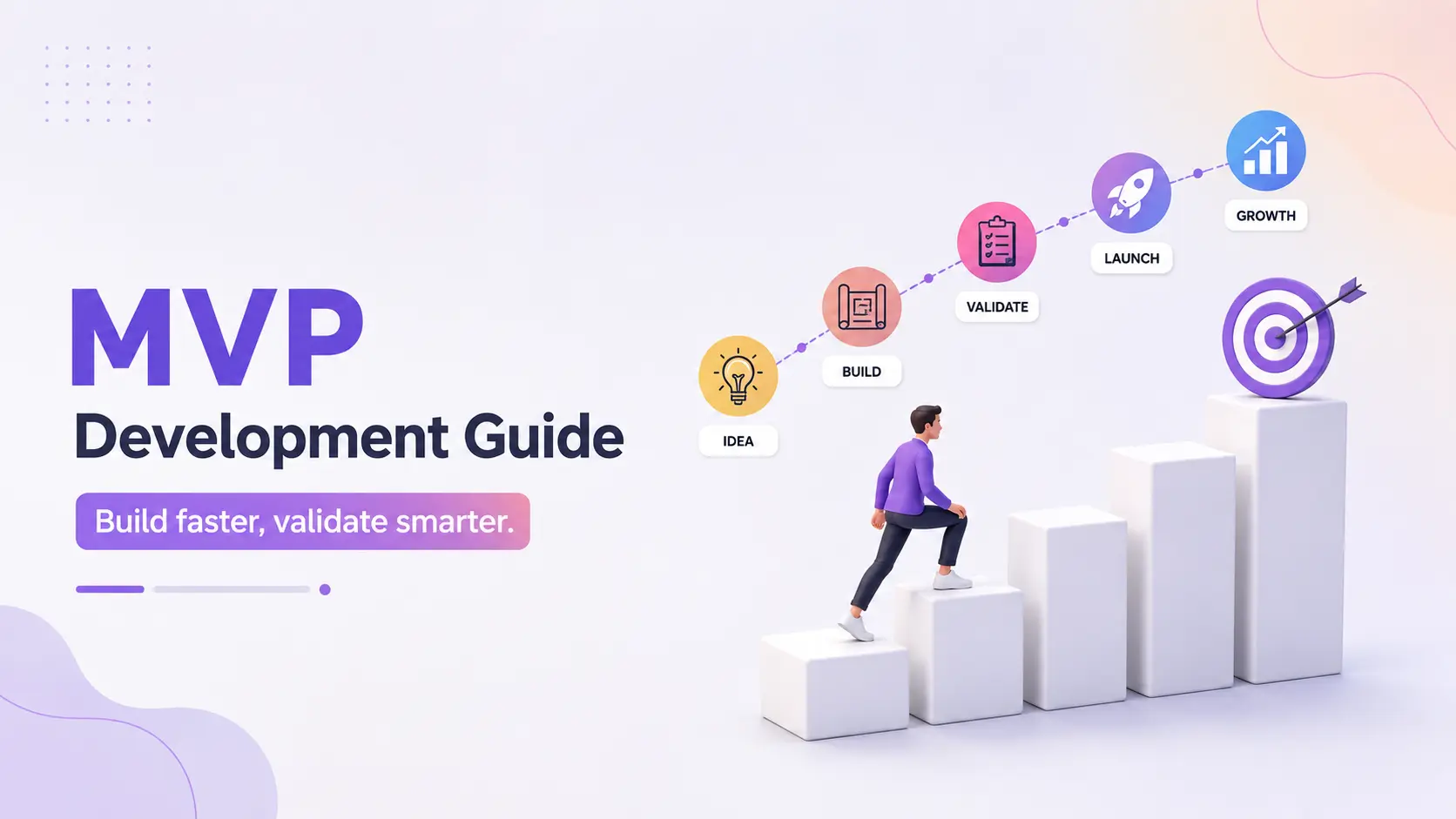
Identify → Prioritise → Build → Launch → Measure → Learn → Improve
For startups, this approach can help reduce unnecessary initial investment.
For established businesses, it can provide a practical way to test new products and digital business models.
At mTouch Labs, our goal is to help businesses turn product ideas into focused, testable digital experiences while keeping development aligned with the business objective.
Build faster. Validate smarter. Scale when the evidence says it's time.
Contact us to discuss your MVP, or request a free quote.
Frequently Asked Questions
What is an MVP in software development?
How is an MVP different from a prototype?
How long does MVP development take?
How much does it cost to build an MVP?
Should an MVP include every important feature?
Can AI be included in an MVP?
Is MVP development only for startups?
What should be measured after launching an MVP?
Should an MVP be scalable?
How can mTouch Labs help with MVP development?
🎯 Key Takeaways
Learn how MVP development helps startups and businesses validate ideas, reduce initial scope, gather user feedback, and build smarter digital products.