




TL;DR — What You'll Learn
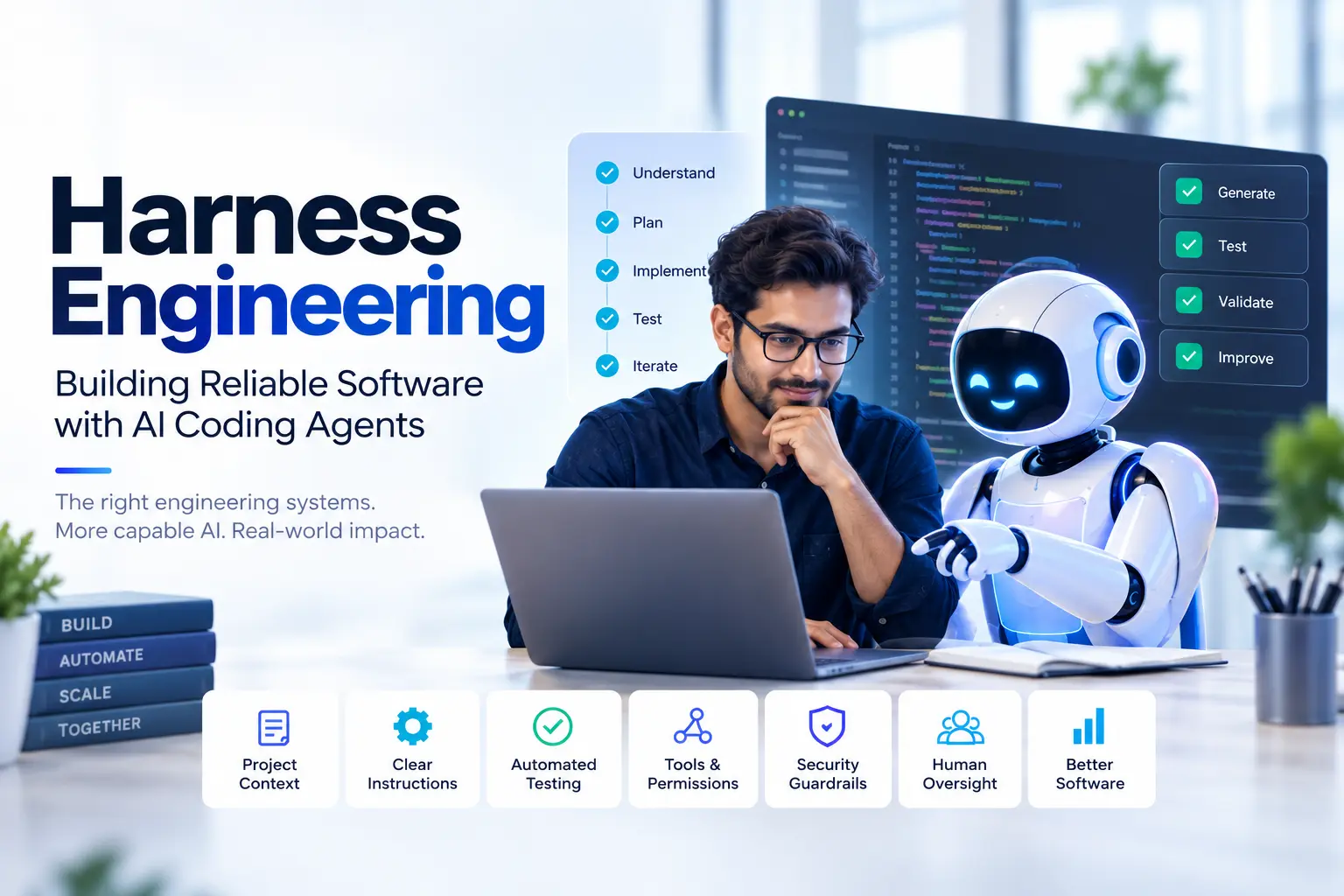
Learn how Harness Engineering helps teams build reliable software with AI coding agents through context, testing, guardrails, automation, and human oversight.
AI coding agents are moving beyond single code suggestions and beginning to perform larger development tasks — navigating a repository, changing multiple files, running commands, and iterating on their own output. That shift raises a different question for engineering teams: not whether the model can write code, but whether the surrounding workflow is designed for it to do so reliably.
This guide explains harness engineering: the practice of designing the context, rules, tools, validation, and controls that let AI coding agents contribute to real software projects.
What Is Harness Engineering?
Harness Engineering is a software engineering approach for creating the right environment, rules, tools, and validation processes for AI coding agents to work reliably on real software projects.
Rather than treating AI as a tool that simply generates code from prompts, harness engineering focuses on the engineering system built around the AI.
An AI coding agent may understand requirements, navigate a repository, modify multiple files, run commands, and fix implementation issues. But producing reliable software requires more than technically valid code. The agent also needs relevant project context, clear engineering expectations, appropriate development tools, and reliable ways to verify its changes.
This makes harness engineering different from basic AI-assisted coding.
In a traditional workflow, a developer may ask an AI tool to generate or modify a piece of code. With harness engineering, the development workflow is designed to help the AI operate within the project's architecture, conventions, testing practices, and operational boundaries. This is the difference between a prompt and a system, and it is where AI software development starts to resemble ordinary engineering discipline.
The central idea is simple: the quality of AI-assisted software development depends not only on the capability of the AI model, but also on the engineering system in which it operates.
A well-designed harness connects AI capabilities with established software engineering practices. It gives agents the information needed to understand the project, the guidance needed to make appropriate implementation decisions, and the validation needed to determine whether their changes actually work.
Harness engineering is therefore not about giving AI maximum freedom. It is about creating controlled autonomy — allowing AI coding agents to perform meaningful development work while keeping quality, reliability, security, and important engineering decisions under appropriate control.
The key question shifts from “How can AI write better code?” to “How should we design software development so AI can build and change software reliably?”
Why AI Coding Agents Need an Engineering Harness
As AI coding agents take on larger development tasks, software teams face a different engineering challenge: how to ensure that AI-generated changes meet the project's quality, architectural, and operational requirements.
Software projects contain business rules, architectural decisions, dependencies, technical constraints, and quality standards. An implementation can compile and appear correct while still introducing a regression, violating an architectural boundary, adding unnecessary complexity, or missing an important requirement.
The larger the task an AI agent performs, the more important these risks become.
A harness provides the engineering structure needed to manage those risks. Instead of evaluating an AI coding agent only by whether it completed a requested task, the development process also evaluates whether the resulting change is correct, compatible, maintainable, and acceptable for the project.
A key principle is: an AI agent can implement a change, but the engineering system should determine whether that change is acceptable.
This creates a model of managed autonomy. AI coding agents can handle meaningful development work without making software quality dependent entirely on their own judgment. The surrounding engineering process establishes expectations and evaluates outcomes. When a change does not meet those expectations, the agent or developer can investigate, revise, and validate it again.
The result is a more reliable development cycle: AI performs the work, the change is evaluated, issues are addressed, and the result is validated.
How AI Changes the Role of Software Engineers
AI coding agents are changing software engineering not only by accelerating implementation, but by shifting where engineers spend their time and judgment.
Traditional development often requires engineers to write code, debug issues, implement repetitive logic, and handle many of the smaller decisions involved in delivering a feature. As AI takes on more of these activities, engineers can spend more time on problems that require broader technical and product understanding. This changes the engineer's role from primarily producing implementation to increasingly directing and evaluating it — a shift that is reshaping how AI software engineering teams are organised.
- which parts of a system are suitable for AI-assisted development
- which architectural decisions should remain human-owned
- what engineering standards must be preserved
- how AI-generated changes should be evaluated
- when a task requires human intervention
This does not make engineering judgment less important. In many cases it makes that judgment more important, because AI can produce multiple implementation options quickly while an engineer must determine which approach best fits the application's architecture, requirements, maintainability, and long-term direction.
Harness engineering reinforces this shift by making engineers responsible for designing the conditions in which AI development takes place. The resulting workflow is less about who writes every line of code and more about how effectively a team turns requirements into reliable software.
What Does an AI Engineering Harness Include?
An AI engineering harness is not a single tool or platform. It is a connected set of engineering practices, project information, tools, and controls that support AI coding agents within a software development workflow.
A practical harness typically includes:
- Project context — information that helps the agent understand the codebase and its structure.
- Engineering instructions — project-specific rules and expectations for implementation.
- Validation mechanisms — tests and automated checks that evaluate changes.
- Development tools — controlled access to the commands and systems required for development tasks.
- Feedback signals — information from test results, errors, builds, and other development outcomes.
- Security controls — boundaries around access, permissions, sensitive systems, and risky operations.
- Human decision points — situations where engineering judgment or approval is required.
These components work together as a connected development workflow: understand the project, perform the work, validate the change, receive feedback, refine the result, and review when required.
Designing Repository Context for AI Coding Agents
For an AI coding agent, the repository is more than a collection of source files. It is one of the primary places where the information needed to make implementation decisions can be discovered. A well-structured repository should make important engineering knowledge easy to find — which is as true for custom software development teams as it is for the agents working alongside them.
Create a Clear Repository Map
AI coding agents should be able to identify the major areas of a project without unnecessary exploration. Clear organization can separate:
- application code
- shared components and libraries
- APIs and services
- database and data-access logic
- configuration
- tests
- infrastructure
- documentation
- development scripts and utilities
The exact structure depends on the technology and architecture, but the goal is consistent: the location and responsibility of important code should be understandable.
Make Architectural Decisions Discoverable
Repository context should also expose information that is not obvious from individual files: application architecture, module responsibilities, service boundaries, integration patterns, important dependencies, data flows, and known technical constraints. When this information is difficult to discover, an AI coding agent may make locally reasonable changes that conflict with broader system design.
Keep Project Conventions Close to the Code
Naming conventions, file organization, error-handling patterns, dependency practices, and testing approaches should be discoverable within the project wherever practical. Documentation also needs to remain aligned with the current implementation — outdated documentation can be as problematic as missing documentation, because it may lead development decisions in the wrong direction.
A useful principle: if important engineering knowledge exists only outside the repository, it is harder to make that knowledge consistently available during AI-assisted development.
Engineering Instructions and Rules for AI Coding Agents
Repository context tells an AI coding agent where to find information. Engineering instructions define how the team expects development work to be performed.
These instructions provide practical guidance for decisions that repeatedly matter across a project. They can cover:
- preferred coding patterns
- naming and file-organization conventions
- architectural boundaries
- dependency policies
- error-handling practices
- testing expectations
- development and validation commands
- rules for modifying sensitive areas
- situations that require human review
The goal is not to create a large rulebook. Instructions are most effective when they are specific, actionable, and relevant to the work being performed. Instead of telling an agent to write “clean code”, a project can define concrete expectations around module boundaries, dependency usage, API behaviour, or error handling.
Instructions can also operate at different levels. General project rules may apply across the codebase, while additional guidance can apply to a particular service, module, or workflow. These rules should evolve with the software: changes to architecture, frameworks, dependencies, or development practices may require corresponding updates to the instruction layer.
Testing as the Verification Layer
For AI coding agents, completing an implementation is only part of the development process. The resulting change must also be checked against the project's expected behaviour. Testing provides an objective way to evaluate AI-generated changes, and it is where software testing services earn their place in an agentic workflow.
Tests as Executable Specifications
Well-designed tests capture expected application behaviour in a form that can be executed repeatedly. This matters especially when an AI coding agent changes existing functionality: tests can confirm that intended behaviour works while helping detect unintended changes to areas that were not part of the task.
Layer Validation Around the Change
- Unit tests verify individual functions or components.
- Integration tests verify interactions between system components.
- End-to-end tests cover important application workflows.
- Type checks and linting identify structural and code-quality issues.
- Build checks confirm that the application can be successfully compiled or packaged.
The right combination depends on the project. The objective is not to maximise the number of checks, but to cover the behaviours and failure modes that matter.
Practical Example: Adding a Payment Method
Suppose an AI coding agent is asked to add a new payment method to an e-commerce application. The change may involve the payment service, API layer, database models, and checkout interface. The task should not be considered complete simply because those files have been modified. Automated checks can verify that the new payment flow works, existing payment methods remain functional, invalid transactions are handled correctly, and the application still builds.
If an existing payment test fails after the change, that failure gives the agent and engineer a concrete signal to investigate and correct the implementation.
Make Completion Measurable
For an AI coding agent, “done” should mean more than code has been generated or modified. A stronger definition of completion is based on acceptance criteria and successful validation.
Tools, Permissions, and Controlled Autonomy
AI coding agents become more useful when they can interact with the tools required to complete development tasks. However, unrestricted access to every system can introduce unnecessary risk. Harness engineering therefore treats tool access and permissions as part of the development design — a familiar constraint in enterprise software development.
Depending on the project, an agent may need access to a terminal, package manager, test runner, build system, database tools, or version-control commands. The important question is what the agent should be allowed to do with each tool.
Practical Example: Updating an API Service
Suppose an AI coding agent is asked to modify an API endpoint. It may need to inspect the repository, edit implementation files, install an approved dependency, run tests, and create a commit. A controlled setup can permit these operations while preventing access to production credentials, infrastructure changes, or deployment commands.
Design Permissions Around Tasks
- Scoped to the work being performed
- Limited to necessary resources
- Auditable where appropriate
- Reversible when access is no longer required
The objective is not to make AI coding agents ineffective through excessive restrictions. It is to provide the capabilities required for productive development while keeping higher-risk operations appropriately controlled.
Feedback Loops and Observability
AI coding agents often need more than a single attempt to complete a development task. They become more effective when the software environment provides useful signals about the results of their actions.
Signals can come from application logs, runtime errors, test and build results, type-checking or linting output, performance checks, and code review findings.
Observability Makes Feedback Actionable
Feedback is most useful when it contains enough information to support diagnosis. A generic message such as “request failed” provides little direction. Structured logs, meaningful error messages, traces, and diagnostic outputs can reveal what happened, where it happened, and what conditions surrounded the failure.
Practical Example: Fixing an API Integration
Consider an AI coding agent modifying an API integration. The implementation passes its initial checks but fails when an external service returns an unexpected response. Useful diagnostic information can reveal the affected endpoint, response status, error condition, and related application behaviour. The agent can use those signals to investigate, adjust the implementation, and run the relevant checks again.
A practical feedback cycle is: change, observe, diagnose, revise, check again.
Security and Guardrails for AI Coding Agents
As AI coding agents become capable of making broader changes and interacting with development systems, security becomes an important part of the engineering workflow. In harness engineering, guardrails define boundaries around actions that could create security, data, or operational risk — the same principles that govern secure software development generally.
- protecting credentials, API keys, and other secrets
- isolating development environments from production systems
- preventing unsafe or destructive commands
- protecting sensitive files and data
- requiring approval for high-impact operations
- maintaining records of important agent actions
Practical Example: Protecting Production Credentials
Consider an AI coding agent working on a backend service that connects to external APIs. The agent may need test credentials to complete development tasks, but production secrets should remain outside its normal working environment. An isolated setup can provide development credentials while keeping production authentication inaccessible.
Guardrails Should Reflect Risk
Not every AI-assisted action presents the same level of risk. Reading source code or running a local test is different from changing infrastructure, accessing sensitive data, or deploying an application. Low-risk development can carry greater automation; high-impact operations need stronger safeguards and human approval.
The goal is not to prevent AI coding agents from performing useful work. It is to ensure that greater autonomy does not automatically result in greater authority.
Human Engineers and Decision Points
Harness engineering does not aim to remove engineers from the software development process. Instead, it helps determine where human judgment adds the most value.
AI coding agents can handle implementation tasks efficiently, but some decisions require broader context than the immediate code change. These may involve product priorities, architectural direction, business rules, compliance requirements, or trade-offs that cannot be evaluated through automated checks alone.
Where Human Judgment Matters
- significant architectural changes
- modifications to critical business logic
- changes with security or compliance implications
- unexpected behaviour discovered during validation
- decisions involving long-term maintainability
- changes that affect multiple systems or teams
The goal is not to manually review every action an AI coding agent performs — excessive intervention can reduce the productivity benefits of agentic development. Instead, teams can establish decision boundaries: routine, low-risk implementation can proceed with greater autonomy, while consequential decisions receive appropriate oversight.
This creates a practical division of responsibility: AI coding agents handle implementation and iteration, automated systems validate measurable behaviour, and engineers make consequential decisions.
Common Harness Engineering Mistakes
Harness engineering can improve AI-assisted software development, but poorly designed workflows can create new problems. Many failures come not from the AI model itself, but from the way the surrounding development environment is designed.
1. Giving AI Too Much Context
More information does not always produce better results. Large amounts of outdated, irrelevant, or duplicated documentation can make it harder for an AI coding agent to identify what actually matters. Better approach: provide focused, current context that is relevant to the task.
2. Relying on Instructions Without Validation
Clear engineering rules can guide implementation, but instructions alone cannot prove that a change works. Better approach: connect guidance with automated tests, builds, type checks, and other measurable validation.
3. Automating High-Impact Decisions
Allowing an AI coding agent to make consequential architectural, infrastructure, or production decisions without appropriate review can increase operational risk. Better approach: define decision boundaries and require human involvement where the impact is significant.
4. Ignoring Failed Feedback
A failing test, build error, or runtime issue is valuable information. Treating it as an inconvenience rather than a signal can cause the same problem to repeat. Better approach: design workflows that allow the agent to inspect failures, revise its implementation, and validate the result again.
5. Treating the Harness as a One-Time Setup
Projects evolve. Architecture, dependencies, testing practices, and security requirements change over time. Better approach: continuously update repository context, instructions, validation, and controls as the software changes.
Practical Implementation Checklist
- Map the repository structure and major architectural boundaries
- Document project-specific engineering instructions
- Define which development tools the agent can use
- Separate development and production environments
- Protect secrets and sensitive data
- Establish automated tests and validation checks
- Define situations requiring human review
- Capture useful build, test, and runtime feedback
- Track agent actions where auditability is important
- Review and update the harness as the project evolves
How to Measure Harness Effectiveness
A harness should not be judged by how many rules, tools, or automated workflows it contains. Its value is determined by whether it helps teams deliver reliable software more effectively with AI coding agents.
Key Metrics to Track
- Task completion rate — how often agents complete assigned tasks successfully.
- First-pass success rate — how frequently changes pass the expected validation without substantial rework.
- Rework rate — how often engineers need to significantly modify AI-generated implementations.
- Defect rate — whether AI-assisted changes introduce more defects or regressions.
- Cycle time — how long it takes to move a task from requirement to validated implementation.
- Review effort — how much engineering time is required to review and correct agent-generated changes.
These metrics should be considered together. A faster development cycle is not necessarily an improvement if it produces more defects or substantially increases review effort.
A Simple Measurement Process
- Establish a baseline. Measure development time, rework, defects, and review effort before introducing or changing the harness.
- Track AI-assisted tasks. Record the same metrics for a defined set of tasks completed with AI coding agents.
- Compare outcomes. Look for changes in speed, quality, rework, and engineering effort rather than focusing on a single metric.
- Identify friction. Determine where agents repeatedly struggle — unclear requirements, missing repository context, failed validation, or excessive review.
- Improve and repeat. Adjust the relevant part of the harness and measure the next group of tasks.
The purpose of measurement is not simply to determine whether an AI coding agent is “good” or “bad”. It is to identify which parts of the engineering environment help or hinder effective AI-assisted development.
Practical Harness Engineering Implementation Roadmap
Teams do not need to redesign their entire development process before adopting harness engineering. A practical approach is to introduce AI coding agents gradually, starting with controlled tasks and expanding their role as the workflow matures. Organisations evaluating AI development services can use the same sequence.
- Select suitable tasks. Start with tasks that have clear requirements and measurable outcomes — bug fixes, isolated features, refactoring, test creation, or documentation updates.
- Prepare the repository. Make the project structure, development commands, testing practices, and important architectural decisions easy to discover. Remove outdated or conflicting documentation.
- Define engineering guidance. Create concise instructions covering important coding patterns, architectural boundaries, testing expectations, and project-specific requirements.
- Connect validation. Ensure AI-generated changes can be evaluated through relevant tests, builds, type checks, linting, and other automated checks.
- Introduce controlled tool access. Provide the tools required for development tasks while restricting access to sensitive systems, credentials, and high-impact operations.
- Establish review boundaries. Define which tasks can proceed with greater autonomy and which require human review or approval.
- Measure and improve. Track completion rates, rework, defects, cycle time, and review effort. Use these results to identify weaknesses and improve the harness.
This incremental approach allows organisations to adopt agentic software development without treating autonomy as an all-or-nothing decision.
How mTouch Labs Approaches AI-Assisted Software Engineering
At mTouch Labs, AI-assisted software development is approached as part of a broader engineering strategy rather than as a standalone code-generation activity. The focus is on helping development teams use AI coding agents where they can create meaningful productivity gains while maintaining the engineering standards required for production software.
Applying AI Where It Adds Value
AI coding agents can support feature implementation, refactoring, test creation, debugging, documentation, and repetitive engineering tasks. The appropriate level of AI involvement depends on the nature of the project and the task.
Combining Automation With Engineering Expertise
AI can increase the speed of implementation, but experienced engineers remain important for understanding business requirements, evaluating technical trade-offs, reviewing critical changes, and maintaining the long-term direction of a software product.
Building for Real-World Delivery
For organisations adopting AI coding agents, the priority should be more than demonstrating that AI can write code. The real objective is a repeatable development workflow that produces maintainable, tested, secure, and production-ready software.
Conclusion
AI coding agents are changing how software can be designed, implemented, tested, and maintained. But their effectiveness depends on more than the capability of the underlying AI model.
Harness Engineering provides the structure that allows AI to participate in software development within defined engineering expectations. By combining accessible project context, clear instructions, appropriate tools, automated validation, useful feedback, security safeguards, and human decision points, organisations can create a more reliable environment for AI-assisted development.
The objective is not to give AI coding agents unlimited autonomy. It is to create the right boundaries so they can handle meaningful engineering work while important quality, security, and architectural decisions remain appropriately controlled.
As AI coding agents become more capable, the organisations that benefit most may not simply be those using the most advanced models. They will be the ones that build effective engineering systems around those models. The future of AI-assisted software development is not just better AI — it is better engineering around AI.
Frequently Asked Questions
What is Harness Engineering?
Why is Harness Engineering important for AI coding agents?
Is Harness Engineering the same as AI-assisted software development?
What should an AI engineering harness include?
How do you test AI-generated code?
Can AI coding agents work without human developers?
How do companies start implementing Harness Engineering?
What is the difference between an AI coding agent and a coding assistant?
Does Harness Engineering replace traditional software engineering practices?
What can mTouch Labs help with in AI-assisted software engineering?
🎯 Key Takeaways
Learn how Harness Engineering helps teams build reliable software with AI coding agents through context, testing, guardrails, automation, and human oversight.