




TL;DR — What You'll Learn
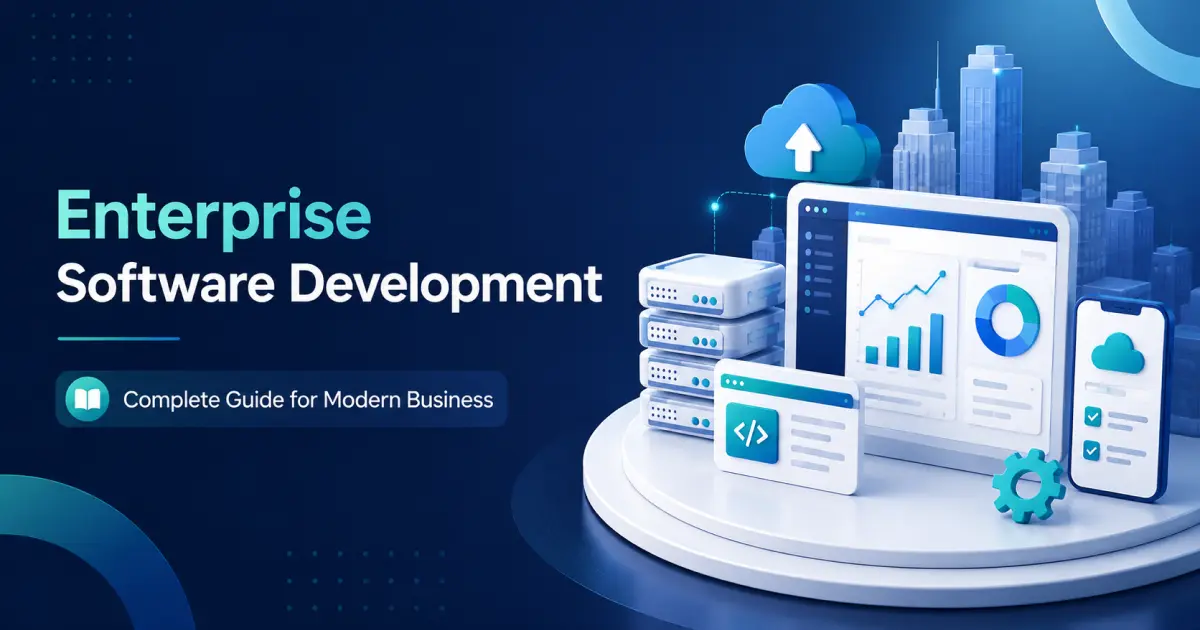
Learn enterprise software development, architecture, AI, cloud, security, costs, and best practices. Discover how custom enterprise solutions help businesses scale.
Introduction
Business growth brings exciting opportunities, but it also introduces new operational challenges. As organizations expand, they often discover that the tools and processes that once supported a small team are no longer capable of handling increasing customer demands, larger workforces, multiple business locations, and growing volumes of data.
Many businesses still rely on disconnected applications, spreadsheets, manual approvals, and legacy systems that operate independently. Sales teams manage customer information in one platform, finance works with another, inventory is tracked elsewhere, and management struggles to obtain accurate, real-time insights. These disconnected systems lead to duplicated work, delayed decision-making, communication gaps, and higher operational costs.
This is why enterprise software has become one of the most important investments for modern organizations, and why choosing the right software development company matters as much as the technology itself.
Enterprise software is more than just a business application—it is the digital foundation that connects departments, automates workflows, centralizes business data, and enables organizations to operate efficiently at scale. Whether a company wants to improve customer experience, optimize internal operations, enhance cybersecurity, or accelerate digital transformation, enterprise software plays a critical role in achieving these objectives.
Today's enterprise applications are also becoming smarter. Technologies such as Artificial Intelligence (AI), Machine Learning (ML), cloud computing, robotic process automation (RPA), predictive analytics, and the Internet of Things (IoT) are transforming enterprise software from simple management systems into intelligent business platforms that support faster and more informed decision-making.
However, building enterprise software is not simply about developing features or selecting the latest technology stack. Successful enterprise software development begins with understanding business objectives, designing scalable architecture, integrating existing systems, ensuring security and regulatory compliance, and creating solutions that continue delivering value as the business evolves.
Whether you're planning to modernize legacy applications, develop a custom enterprise platform, migrate to the cloud, or implement AI-powered business solutions, understanding enterprise software development is essential before making technology investments.
This guide explains everything business leaders need to know—from enterprise software fundamentals and architecture to development processes, AI integration, security, cost considerations, and selecting the right development partner.
Quick Answer: What Is Enterprise Software Development?
Enterprise software development is the process of designing, developing, integrating, deploying, and maintaining software solutions that help organizations manage complex business operations, automate workflows, improve collaboration, strengthen security, and support long-term business growth.
Unlike consumer applications or standard business software, enterprise applications are built for organizations that require high performance, scalability, reliability, and seamless integration across multiple departments and business systems.
In Simple Terms
Think of enterprise software as the central operating system of a business.
Instead of managing finance, sales, human resources, inventory, procurement, customer support, and reporting through separate applications, enterprise software connects these functions into a unified ecosystem where information flows securely and efficiently.
This enables organizations to reduce manual work, improve productivity, make faster decisions, and deliver better customer experiences.
Common Examples of Enterprise Software
- Enterprise Resource Planning (ERP)
- Customer Relationship Management (CRM)
- Human Resource Management Systems (HRMS)
- Supply Chain Management (SCM)
- Financial Management Systems
- Business Intelligence (BI) Platforms
- Enterprise Content Management (ECM)
- Customer & Vendor Portals
- AI-Powered Enterprise Applications
- Workflow Automation Platforms
Key Benefits
- Automates repetitive business processes
- Centralizes business information
- Connects multiple departments through one platform
- Improves operational efficiency
- Enhances data security and compliance
- Enables real-time analytics and reporting
- Supports business scalability
- Integrates with cloud services and third-party applications
Why Enterprise Software Matters in 2026
Digital transformation is no longer optional. Businesses across industries are investing in modern enterprise solutions to improve efficiency, reduce operational costs, and remain competitive in rapidly changing markets.
Organizations today must manage increasing customer expectations, distributed workforces, cybersecurity risks, regulatory requirements, and growing volumes of business data. Traditional software systems often struggle to support these evolving demands.
Enterprise software solves these challenges by creating a connected digital ecosystem where information moves seamlessly across the organization.
For example, when a customer places an order, an enterprise application can automatically verify inventory, notify the finance department, generate invoices, update warehouse stock, initiate shipping, and provide executives with real-time dashboards—all without manual intervention.
This level of automation significantly reduces operational delays, minimizes human error, and allows employees to focus on strategic tasks rather than repetitive administrative work.
Several key trends are accelerating enterprise software adoption:
- Digital Transformation: Organizations are replacing legacy systems with modern, integrated platforms.
- Cloud-First Strategy: Cloud-native enterprise applications provide better scalability, flexibility, and accessibility.
- Artificial Intelligence: AI enables predictive analytics, intelligent automation, virtual assistants, and smarter decision-making.
- Cybersecurity: Businesses require secure applications that protect sensitive information and support compliance with industry regulations.
- Data-Driven Decision Making: Real-time dashboards and analytics help organizations respond quickly to changing business conditions.
- Customer-Centric Operations: Integrated enterprise platforms enable personalized customer experiences and faster service delivery.
As organizations continue to embrace digital innovation, enterprise software has evolved from being an IT investment to becoming a strategic business asset that drives productivity, innovation, and long-term growth.
What Is Enterprise Software Development?
Enterprise software development is the practice of creating customized software solutions that support the complex operational requirements of medium-sized businesses, large enterprises, and multinational organizations.
Unlike off-the-shelf software designed for general business use, custom software development is built around an organization's unique workflows, business objectives, compliance requirements, and future growth plans. It provides a centralized platform where multiple departments—including sales, finance, operations, procurement, customer support, and executive management—can work together using shared data and standardized processes.
One of the defining characteristics of enterprise software is its ability to scale. As organizations expand into new markets, hire more employees, process larger volumes of transactions, or introduce new products and services, the software must continue to perform reliably without compromising speed, security, or user experience.
Modern enterprise application development also integrates with a wide range of business systems, including payment gateways, CRM platforms, ERP solutions, HR software, cloud infrastructure, analytics tools, third-party APIs, and AI services. This interconnected approach helps organizations eliminate data silos, improve collaboration, and create a unified digital ecosystem.
More importantly, enterprise software development is not only about technology—it is about solving real business problems. A successful enterprise solution streamlines operations, improves productivity, supports informed decision-making, reduces operational risks, and enables organizations to adapt quickly to changing market conditions.
As businesses continue to adopt AI, automation, cloud computing, and advanced analytics, enterprise software development will remain at the center of digital transformation strategies, helping organizations become more agile, innovative, and future-ready.
Why Do Businesses Need Enterprise Software?
As businesses grow, operations become increasingly complex. New departments are created, customer expectations rise, regulatory requirements evolve, and data is generated across multiple systems every day. Managing these operations with disconnected applications or manual processes often leads to inefficiencies that slow business growth.
Enterprise software addresses these challenges by creating a centralized digital ecosystem where people, processes, and information work together. Instead of relying on separate tools for each department, organizations can manage critical business functions through integrated applications that improve collaboration, automate workflows, and provide real-time visibility.
Here are some of the key reasons organizations invest in enterprise software development.
1. Streamline Business Operations
Many organizations spend countless hours on repetitive tasks such as data entry, approvals, report generation, inventory updates, invoice processing, and customer communication.
Enterprise software automates these workflows, reducing manual effort and improving operational efficiency. Employees can focus on strategic initiatives instead of repetitive administrative work, leading to better productivity and faster business outcomes.
2. Improve Cross-Department Collaboration
Departments often work with different applications and databases, making it difficult to share accurate information.
Enterprise software creates a unified platform where sales, finance, HR, procurement, operations, customer support, and leadership teams access the same real-time information. This improves communication, reduces duplication, and enables faster decision-making.
3. Make Better Business Decisions
Successful organizations rely on data rather than assumptions.
Enterprise applications collect information from multiple business functions and present it through dashboards, reports, and analytics. Decision-makers gain a comprehensive view of business performance, helping them identify opportunities, reduce risks, and respond quickly to market changes.
4. Scale Without Operational Complexity
Business growth should not require rebuilding systems every few years.
Well-designed enterprise software is built with scalability in mind. Whether an organization expands into new locations, hires more employees, launches new services, or serves additional customers, the software can grow alongside the business while maintaining performance and reliability.
5. Strengthen Security and Compliance
Enterprise applications often manage sensitive information such as financial records, customer data, employee details, and confidential business documents.
Modern enterprise software includes advanced security features such as:
- Role-based access control
- Multi-factor authentication (MFA)
- Data encryption
- Audit logs
- Secure API integrations
- Backup and disaster recovery
- Compliance monitoring
These capabilities help organizations reduce security risks while meeting industry regulations.
6. Deliver Better Customer Experiences
Customers expect faster responses, personalized services, and seamless interactions across multiple channels.
Enterprise software connects customer information, support systems, order management, billing, and communication tools into one ecosystem. This enables organizations to provide consistent and personalized experiences while improving customer satisfaction and retention.
7. Reduce Long-Term Operational Costs
Although enterprise software requires an initial investment, it often reduces long-term costs by:
- Eliminating duplicate work
- Reducing manual errors
- Improving employee productivity
- Optimizing resource utilization
- Automating repetitive processes
- Reducing maintenance of multiple disconnected systems
Over time, these improvements contribute to a stronger return on investment (ROI).
Key Characteristics of Enterprise Software
Not every business application qualifies as enterprise software. Enterprise solutions are specifically designed to support complex organizational requirements and large-scale operations.
Below are the defining characteristics of modern enterprise software.
Scalability
Enterprise software must support increasing numbers of users, transactions, and data without affecting performance. Whether a business has 100 employees or 10,000, the system should continue operating efficiently.
Reliability
Downtime can disrupt operations and affect customer trust.
Enterprise applications are designed with high availability, redundancy, automated backups, and disaster recovery strategies to ensure continuous business operations.
Security
Security is a fundamental requirement.
Enterprise software typically includes:
- Encryption
- Identity management
- Role-based permissions
- Security monitoring
- Compliance controls
- Threat detection
These measures protect sensitive business information from unauthorized access.
Integration Capabilities
Organizations rarely use a single software platform.
Enterprise solutions integrate with:
- CRM systems
- ERP platforms
- HRMS
- Payment gateways
- Cloud services
- Third-party APIs
- Business Intelligence tools
- Marketing platforms
This eliminates data silos and improves operational efficiency, typically delivered through dedicated API development services.
Customization
Every organization has unique workflows.
Custom enterprise software allows businesses to tailor dashboards, approvals, reports, permissions, business rules, and automation according to operational requirements instead of adapting their processes to generic software.
Automation
Modern enterprise applications automate repetitive workflows such as:
- Employee onboarding
- Invoice approvals
- Procurement requests
- Inventory updates
- Customer notifications
- Workflow routing
- Report generation
Automation improves speed, accuracy, and consistency across the organization.
Analytics and Reporting
Enterprise software transforms business data into meaningful insights through:
- Executive dashboards
- KPI tracking
- Predictive analytics
- Financial reports
- Operational reports
- Performance monitoring
These capabilities support informed business decisions.
Enterprise Software vs Traditional Business Software
Although both support business operations, they serve different purposes and levels of organizational complexity.
| Feature | Enterprise Software | Traditional Business Software |
|---|---|---|
| Target Users | Medium & Large Organizations | Individuals & Small Businesses |
| Scalability | High | Limited |
| Customization | Extensive | Basic |
| Integration | Multiple Enterprise Systems | Limited Integrations |
| Departments Supported | Multiple Departments | Single Team or Function |
| Security | Enterprise-grade | Standard |
| Automation | Advanced Workflow Automation | Basic Automation |
| Reporting | Real-time Dashboards & Analytics | Standard Reports |
| Deployment | Cloud, Hybrid, On-Premise | Usually Cloud or Desktop |
| Long-Term Growth | Designed for Business Expansion | Suitable for Smaller Operations |
Real-World Example
Imagine a retail company operating 150 stores across multiple cities.
If each department uses separate tools for inventory, sales, finance, HR, customer support, and procurement, employees spend valuable time transferring information manually between systems. Inventory inaccuracies increase, reporting becomes slower, and management struggles to obtain a complete view of business performance.
Now consider the same company using an integrated enterprise platform.
A product sale automatically updates inventory, records financial transactions, adjusts warehouse stock, triggers replenishment if inventory reaches predefined thresholds, updates customer loyalty information, and reflects the latest figures on executive dashboards in real time.
This connected workflow improves operational efficiency, reduces manual errors, and enables leadership teams to make faster, data-driven decisions.
Ultimately, enterprise software is not just about technology—it is about creating a connected organization where every department works together efficiently to support business growth.
Types of Enterprise Software
Enterprise software is not a single application. It is a broad category of business solutions designed to address specific operational challenges while working together as an integrated ecosystem. Depending on an organization's size, industry, and goals, multiple enterprise applications may be connected to streamline end-to-end business operations.
Enterprise Resource Planning (ERP)
Enterprise Resource Planning (ERP) software integrates core business functions such as finance, procurement, inventory, manufacturing, sales, and operations into a single platform.
Instead of maintaining separate systems for each department, ERP enables organizations to manage critical processes using shared data, improving efficiency and reducing duplication.
Common Use Cases
- Financial management
- Inventory management
- Procurement
- Manufacturing
- Supply chain operations
- Asset management
Customer Relationship Management (CRM)
CRM software helps organizations manage customer interactions throughout the entire customer lifecycle—from lead generation and sales to customer support and retention.
A modern CRM centralizes customer information, improves sales productivity, automates follow-ups, and provides valuable insights into customer behavior.
Common Use Cases
- Lead management
- Sales pipeline tracking
- Customer support
- Marketing automation
- Customer engagement
Human Resource Management System (HRMS)
HRMS solutions simplify employee management by automating recruitment, onboarding, payroll, attendance, leave management, performance tracking, and employee records.
These systems reduce administrative workload while improving employee experiences.
Supply Chain Management (SCM)
Supply Chain Management software improves visibility across procurement, inventory, logistics, warehousing, supplier management, and order fulfillment.
Organizations use SCM systems to optimize inventory levels, reduce operational costs, and improve delivery efficiency.
Enterprise Content Management (ECM)
Organizations generate thousands of documents every day.
ECM systems help securely store, organize, search, share, and manage business documents while maintaining compliance and version control.
Business Intelligence (BI)
Business Intelligence platforms transform raw business data into dashboards, reports, visualizations, and predictive insights that support executive decision-making.
Instead of relying on spreadsheets, leadership teams gain real-time visibility into business performance.
AI-Powered Enterprise Applications
Artificial Intelligence is rapidly becoming a standard component of enterprise software.
Modern enterprise applications now include:
- AI-powered search
- Intelligent document processing
- Predictive analytics
- Recommendation engines
- AI chatbots
- Workflow automation
- Fraud detection
- Demand forecasting
Rather than replacing employees, AI helps teams make faster and more informed decisions while automating repetitive tasks. Multi-tenant products in this category are often delivered as part of SaaS development services.
Enterprise Software Development Lifecycle
Building enterprise software involves much more than writing code. A successful project follows a structured development lifecycle that minimizes risk, aligns technology with business objectives, and ensures long-term scalability.
1. Business Discovery
Every successful project begins with understanding the business.
Development teams collaborate with stakeholders to identify:
- Business goals
- Existing challenges
- User requirements
- Current workflows
- Integration needs
- Compliance requirements
- Success metrics
This discovery phase ensures that technology decisions align with business objectives rather than assumptions.
2. Requirements Analysis
After discovery, functional and technical requirements are documented.
This includes:
- User roles
- Features
- Business rules
- Security requirements
- Performance expectations
- API integrations
- Reporting needs
A well-defined requirements document significantly reduces project risks during development.
3. Solution Architecture
Architects design the overall structure of the application, including:
- System architecture
- Database design
- Cloud infrastructure
- API strategy
- Security model
- Scalability planning
- Integration architecture
Choosing the right architecture early helps prevent expensive redesigns later.
4. UI/UX Design
Enterprise applications should not only be powerful—they should also be easy to use.
Design teams create:
- User journeys
- Wireframes
- Interactive prototypes
- Dashboard layouts
- Responsive interfaces
- Accessibility-focused designs
A well-designed user experience increases employee adoption and reduces training time. Strong UI/UX design services pay for themselves in adoption.
5. Development
Developers build the application using agile methodologies, allowing features to be delivered incrementally while incorporating stakeholder feedback throughout the project.
Development typically includes:
- Frontend implementation
- Backend development
- Database creation
- API integrations
- Authentication
- Workflow automation
- AI capabilities
- Third-party integrations
6. Quality Assurance & Testing
Before deployment, the software undergoes extensive testing to ensure reliability.
Common testing activities include:
- Functional testing
- Performance testing
- Security testing
- API testing
- Integration testing
- User acceptance testing (UAT)
Testing helps identify issues before they affect business operations.
7. Deployment
After successful testing, the application is deployed using carefully planned release strategies.
Organizations may choose:
- Cloud deployment
- Hybrid deployment
- On-premise deployment
Deployment also includes monitoring, backup configuration, and rollback planning.
8. Continuous Improvement
Enterprise software is never truly "finished."
After launch, development teams continue to:
- Monitor performance
- Improve security
- Add new features
- Optimize workflows
- Upgrade integrations
- Incorporate user feedback
Continuous improvement through ongoing application maintenance and support ensures the software evolves alongside changing business needs.
Enterprise Software Architecture
A strong architecture forms the backbone of every successful enterprise application. The right architectural approach improves scalability, security, maintainability, and long-term performance.
Monolithic Architecture
A monolithic application is built as a single unified system.
Best suited for:
- Smaller enterprise projects
- Faster initial development
- Simple business workflows
Limitations
- Difficult to scale individual components
- Slower deployments
- Higher maintenance complexity as the application grows
Microservices Architecture
Microservices divide an application into smaller independent services that communicate through APIs.
Each service can be developed, deployed, and scaled independently.
Benefits
- High scalability
- Faster deployments
- Better fault isolation
- Independent development teams
- Easier maintenance
This architecture is widely adopted by enterprises building cloud-native applications.
Event-Driven Architecture
In event-driven systems, business events trigger automated processes across multiple applications.
For example:
- Customer places an order
- Inventory updates automatically
- Warehouse receives notification
- Finance generates invoice
- Customer receives confirmation
- Management dashboard updates instantly
This approach enables highly responsive and scalable enterprise systems.
Recommended Technology Stack for Enterprise Software
Selecting the right technology stack depends on business goals, scalability requirements, security needs, and future growth plans.
A modern enterprise technology stack commonly includes:
Frontend
- React.js
- Next.js
- Angular
- Vue.js
These are commonly delivered by a specialist web development company.
Backend
- Node.js
- Java Spring Boot
- .NET
- Python (Django/FastAPI)
Mobile
- Flutter
- React Native
- Native Android
- Native iOS
See our mobile app development company services for these platforms.
Databases
- PostgreSQL
- MySQL
- MongoDB
- Microsoft SQL Server
- Redis
Cloud Platforms
- Amazon Web Services (AWS)
- Microsoft Azure
- Google Cloud Platform (GCP)
DevOps & CI/CD
- Docker
- Kubernetes
- GitHub Actions
- Jenkins
- Terraform
These are supported by our cloud & DevOps services.
AI & Analytics
- OpenAI APIs
- Azure AI Services
- TensorFlow
- Power BI
- Tableau
The ideal technology stack should align with the organization's current requirements while remaining flexible enough to support future innovation, integrations, and business expansion.
Artificial Intelligence in Enterprise Software
Artificial Intelligence (AI) is transforming enterprise software from a system that simply stores information into one that analyzes data, predicts outcomes, and automates decision-making. Instead of relying solely on manual processes, organizations can leverage AI to improve operational efficiency, reduce costs, and deliver better customer experiences.
Modern enterprise applications increasingly integrate AI capabilities across departments, enabling businesses to work smarter rather than harder. A generative AI development company can embed these capabilities without disrupting existing workflows.
Popular AI Use Cases in Enterprise Software
Intelligent Document Processing
AI can automatically extract, classify, and validate information from invoices, purchase orders, contracts, insurance claims, and other business documents, significantly reducing manual effort.
Predictive Analytics
Using historical and real-time data, AI helps businesses forecast sales, customer demand, inventory requirements, equipment maintenance schedules, and financial performance.
AI Chatbots & Virtual Assistants
AI-powered assistants provide instant support to customers and employees by answering frequently asked questions, handling routine requests, and guiding users through business processes.
Workflow Automation
Enterprise AI can intelligently automate approval processes, prioritize service requests, detect anomalies, recommend next actions, and optimize operational workflows.
Personalized Customer Experiences
By analyzing customer preferences and purchasing behavior, AI enables organizations to deliver personalized recommendations, targeted campaigns, and improved customer engagement.
Fraud Detection & Risk Analysis
Financial institutions and enterprise organizations use AI to identify suspicious activities, monitor transactions, and minimize business risks through real-time anomaly detection.
As AI technology continues to evolve, enterprise software will become increasingly intelligent, enabling organizations to make faster, data-driven decisions while improving productivity across every department. For sector-specific examples, see our breakdown of AI use cases by industry.
Security and Compliance in Enterprise Software
Enterprise applications often manage sensitive information, including financial records, customer data, employee information, contracts, and intellectual property. Protecting this information is essential for maintaining customer trust and ensuring business continuity.
A secure enterprise application should include multiple layers of protection throughout the software development lifecycle.
Enterprise Security Best Practices
- Role-Based Access Control (RBAC)
- Multi-Factor Authentication (MFA)
- End-to-End Data Encryption
- Secure API Authentication
- Identity and Access Management (IAM)
- Continuous Security Monitoring
- Audit Logs and Activity Tracking
- Automated Backup and Disaster Recovery
- Secure DevSecOps Practices
- Regular Penetration Testing
Organizations operating in industries such as healthcare, banking, insurance, education, and government should also ensure compliance with relevant regulatory standards applicable to their business.
Factors That Influence Enterprise Software Development Cost
There is no universal pricing model for enterprise software because every organization has different business processes, technology requirements, and long-term objectives.
The overall investment depends on several factors.
Project Complexity
Applications supporting multiple departments, business workflows, and enterprise integrations naturally require greater planning and development effort.
Features & Functionalities
Advanced capabilities such as AI, workflow automation, dashboards, reporting, document management, and mobile applications increase project scope.
Third-Party Integrations
Connecting with ERP platforms, CRM systems, payment gateways, cloud services, analytics platforms, IoT devices, and external APIs adds development complexity.
Security & Compliance
Industries requiring strict security controls, audit capabilities, and compliance standards require additional implementation and testing.
Deployment Model
Whether the solution is deployed on the cloud, on-premise, or in a hybrid environment also impacts infrastructure planning and long-term maintenance.
Instead of evaluating only the initial development cost, organizations should consider the long-term return on investment achieved through automation, improved efficiency, reduced operational costs, and business scalability. For a full breakdown of pricing variables, read our custom software development cost guide.
How to Choose the Right Enterprise Software Development Company
Selecting the right technology partner is just as important as selecting the right technology.
An experienced enterprise software development company should understand your business objectives before recommending technical solutions.
When evaluating a development partner, consider the following:
Proven Industry Experience
Review their portfolio, case studies, and experience delivering enterprise applications across industries.
Technical Expertise
Ensure the team has expertise in enterprise architecture, cloud platforms, AI integration, cybersecurity, DevOps, APIs, and scalable application development.
Business-First Approach
Technology should solve business challenges. A reliable partner spends time understanding workflows, operational bottlenecks, and long-term goals before proposing a solution.
Transparent Development Process
Look for companies that follow agile methodologies, provide regular project updates, involve stakeholders throughout development, and maintain clear communication.
Long-Term Support
Enterprise software requires continuous maintenance, security updates, feature enhancements, and performance optimization after launch. Choose a partner committed to long-term success rather than one-time delivery.
Future Trends in Enterprise Software Development
Enterprise technology continues to evolve rapidly. Organizations investing in modern enterprise software should also prepare for emerging technologies that will shape business operations over the next decade.
Key trends include:
- Agentic AI and autonomous business assistants
- Hyperautomation across enterprise workflows
- Cloud-native and serverless enterprise applications
- Low-code and no-code platforms for internal operations
- Digital twins for enterprise asset management
- AI-powered cybersecurity
- Predictive and prescriptive analytics
- Blockchain-enabled enterprise transactions
- IoT integration for real-time operational visibility
- Sustainable and energy-efficient cloud infrastructure
Businesses that strategically adopt these technologies as part of a broader digital transformation programme will improve agility, innovation, and long-term competitiveness.
Why Choose mTouch Labs for Enterprise Software Development?
Building enterprise software requires more than technical expertise—it requires a deep understanding of business operations, scalability, security, and digital transformation.
At mTouch Labs, we develop custom enterprise software solutions tailored to your organization's unique business requirements. Our team combines expertise in enterprise application development, AI integration, cloud technologies, mobile applications, web platforms, DevOps, API development, and system modernization to deliver secure, scalable, and future-ready solutions.
Our Enterprise Software Development Services Include
- Enterprise Application Development
- Custom Software Development
- Enterprise Web & Mobile Applications
- Legacy System Modernization
- Cloud Migration & Cloud-Native Development
- AI & Machine Learning Integration
- API Development & Third-Party Integrations
- Workflow Automation Solutions
- Enterprise UI/UX Design
- Application Maintenance & Support
Whether you're building a new enterprise platform, modernizing legacy software, or accelerating your digital transformation journey, our team helps transform complex business challenges into innovative digital solutions. Explore our software development case studies to see how.
Key Takeaways
- Enterprise software connects departments, processes, and data through a unified platform.
- Custom enterprise software improves operational efficiency, scalability, and security.
- AI, automation, cloud computing, and analytics are shaping the future of enterprise applications.
- Choosing the right architecture and technology partner is critical for long-term success.
- Continuous maintenance, security, and optimization ensure enterprise software continues delivering business value.
Ready to plan your enterprise platform? Contact us for a consultation with our solution architects.
Frequently Asked Questions
What is enterprise software development?
What is the difference between enterprise software and regular business software?
What are the benefits of custom enterprise software development?
Which industries benefit from enterprise software?
How long does enterprise software development take?
How much does custom enterprise software development cost?
How do I choose the right enterprise software development company?
Can enterprise software integrate with existing business systems?
Why choose mTouch Labs for enterprise software development?
Does mTouch Labs modernize legacy enterprise applications?
🎯 Key Takeaways
Learn enterprise software development, architecture, AI, cloud, security, costs, and best practices. Discover how custom enterprise solutions help businesses scale.