




TL;DR — What You'll Learn
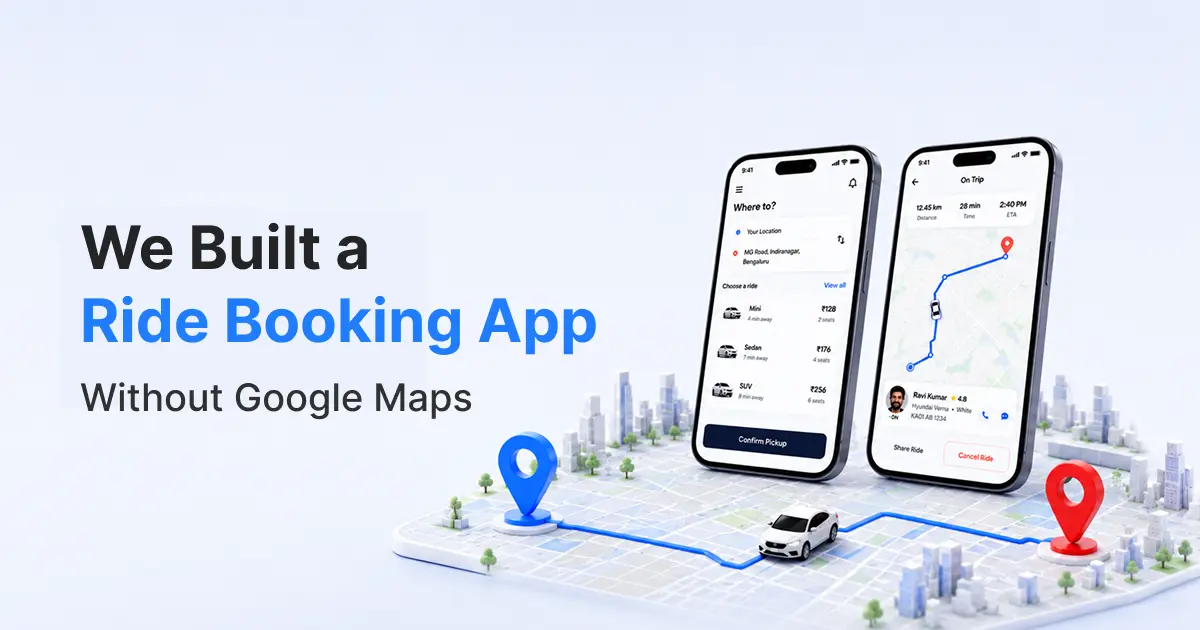
Discover how mTouch Labs built a ride booking app without Google Maps using OpenStreetMap and modern technologies to deliver a scalable, seamless user experience.
Building a ride-booking application has become a common goal for startups entering the mobility, transportation, and hyperlocal services market. Most development teams instinctively choose Google Maps because it has long been considered the standard for mapping, navigation, and location services.
At mTouch Labs, we decided to take a different approach.
Instead of following the conventional path, our engineering team wanted to answer a simple question: Can a modern ride-booking application deliver a seamless user experience without depending on Google Maps?
This wasn't just a technical experiment. It was an opportunity to rethink how location-based applications are designed, how mapping technologies have evolved, and whether open technologies are mature enough for production-grade mobility platforms.
What started as a proof of concept quickly became an engineering exercise that challenged several assumptions about map providers, routing engines, scalability, and user experience.
In this article, we share why we built a ride-booking app without Google Maps, the technologies we selected, the challenges we encountered, and the lessons we believe every startup should know before choosing a mapping solution. If you're planning a similar build, our Mobile App Development Company and Custom Software Development Company teams can help you scope it.
Rethinking the Default Choice
When developers start building a location-based application, selecting a mapping platform is often one of the first technical decisions.
Because Google Maps has been widely adopted for years, many teams rarely evaluate alternative approaches. While it offers a rich ecosystem of APIs and developer tools, relying on a single proprietary platform is not always the best fit for every product.
As engineers, we wanted to understand whether a modular architecture based on open technologies could deliver the same level of usability while giving us greater flexibility over our infrastructure.
Our objective was never to replace Google Maps simply for the sake of using something different. Instead, we wanted to validate whether modern open-source mapping technologies could support the real-time requirements of a ride-booking platform. This is exactly the kind of evaluation our Ride Booking App Development and Enterprise Application Development teams run for every new mobility project.
Defining the Right Goals Before Choosing the Technology
Before selecting any framework or mapping engine, we focused on the product requirements rather than the technology itself.
A successful ride-booking application needs much more than displaying roads on a map.
Users expect accurate pickup locations, live driver tracking, smooth route visualization, reliable location search, quick response times, and consistent performance during peak usage.
Instead of asking, "Which map provider should we use?" we asked, "What experience do we want to deliver?"
That change in perspective helped us design an architecture around user expectations rather than around a specific vendor.
Building with Open Technologies
To support our proof of concept, we adopted an open and modular technology stack that allowed each component to perform a specific responsibility.
OpenStreetMap served as the foundation for geographic data, while dedicated routing and spatial technologies handled navigation, route calculations, and location processing.
By separating responsibilities across different services, we gained more flexibility to optimize performance, improve scalability, and customize the platform according to business requirements.
This modular approach also made the system easier to maintain and extend as new features were introduced — the same approach our Web Development Company and Next.js Development Services teams use on modern web builds.
The Real Challenges Had Nothing to Do with Maps
One of the biggest surprises during development was realizing that displaying a map was one of the easiest parts of the project.
The real complexity came from designing reliable real-time experiences.
Questions such as how often driver locations should refresh, how to efficiently identify nearby drivers, how to minimize latency, and how to maintain responsiveness under heavy traffic required much more attention than choosing a mapping provider.
These challenges highlighted an important lesson: successful ride-booking platforms are built on strong system architecture, not just mapping APIs — which is why scalable infrastructure from our Cloud & DevOps Services team matters as much as the mapping layer itself.
User Experience Comes First
From a customer's perspective, the underlying map provider is rarely the deciding factor.
Passengers care about whether the driver arrives at the correct location, whether routes are accurate, whether pickup estimates are reliable, and whether the application feels responsive.
By optimizing data flow, caching, backend processing, and map rendering, we were able to create a smooth user experience without asking users to compromise on quality.
Our experience reinforced the idea that user satisfaction depends far more on thoughtful engineering than on the logo displayed in the corner of the map — something our UI/UX Design Services team keeps front and center on every project.
Lessons That Changed Our Perspective
Every engineering project teaches valuable lessons, and this proof of concept was no exception.
The first lesson was that technology decisions should always be driven by business requirements rather than industry trends.
The second lesson was that modular architectures provide significantly greater flexibility than tightly coupled ecosystems.
We also discovered that investing time in optimizing backend services, routing logic, and location updates had a greater impact on application performance than changing mapping providers.
Finally, we learned that modern open technologies have matured considerably and are capable of supporting sophisticated, real-time applications when implemented correctly — especially when paired with AI App Development Services for smarter dispatch and demand prediction, running on solid Cloud Services infrastructure.
Is Building Without Google Maps the Right Choice for Every Startup?
There is no single answer.
Some businesses may benefit from managed commercial mapping services because of their specific requirements or development timelines.
Others may prefer open-source mapping technologies to gain greater control over customization, infrastructure, and long-term scalability.
The most important factor is understanding the product's needs before selecting the technology.
Choosing a mapping platform should be a strategic engineering decision—not simply a default option.
How mTouch Labs Helps Businesses Build Smarter Mobility Solutions
At mTouch Labs, we specialize in building scalable mobility platforms, ride-booking applications, logistics systems, and location-based solutions tailored to modern business requirements.
Our engineering team evaluates each project based on scalability, performance, maintainability, and future growth rather than relying on one-size-fits-all technology choices.
Whether a business requires a commercial mapping ecosystem, an open-source implementation, or a hybrid architecture, we focus on designing solutions that align with both technical and business goals.
Our expertise includes Mobile App Development Services, delivery applications, fleet management systems, real-time tracking solutions, Enterprise Mobility Solutions, and Custom Software Development powered by modern cloud-native technologies.
Conclusion
Building our ride-booking application without Google Maps challenged many assumptions we had about modern mapping technologies.
Rather than proving that one platform is universally better than another, the project demonstrated that thoughtful architecture, careful planning, and the right technology stack have a far greater impact on user experience than the choice of a single map provider.
As mapping ecosystems continue to evolve, startups now have more options than ever before.
The key is selecting technologies that support long-term scalability, operational flexibility, and exceptional customer experiences.
At mTouch Labs, this project reinforced an important belief: the best technology decisions are not based on popularity—they are based on solving real business problems efficiently and sustainably.
Want to explore a mapping architecture for your own product? Contact mTouch Labs or View Our Portfolio.
Frequently Asked Questions
Why did mTouch Labs build a ride booking app without Google Maps?
Can a ride booking app work without Google Maps?
Why did mTouch Labs choose OpenStreetMap?
Does OpenStreetMap provide a good user experience for ride booking applications?
What challenges did mTouch Labs face while developing the ride booking application?
Which industries can benefit from OpenStreetMap-powered applications?
Does mTouch Labs develop custom ride booking applications?
Can mTouch Labs migrate an existing ride booking application from Google Maps to OpenStreetMap?
Why choose mTouch Labs for ride booking app development?
🎯 Key Takeaways
Discover how mTouch Labs built a ride booking app without Google Maps using OpenStreetMap and modern technologies to deliver a scalable, seamless user experience.